Circular and Resilient Urban Water Management: A Compendium of Solutions for Local and Regional Authorities
Initiative for Circular Water Resilience in Urban Areas in Morocco
August 2025
ICLEI-Local Governments for Sustainability
In a world where cities are struggling under the weight of resource scarcity and climate change, water has emerged as one of the most pressing challenges of the 21st century.
Faced with prolonged droughts, devastating floods and rampant pollution, cities – which are on the front line – must rethink their relationship with this vital resource. This collection, the result of an international collaboration led by ICLEI – Local Governments for Sustainability, explores 12 case studies from around the globe, revealing how circular and resilient approaches can transform urban water management. From Tokyo to Safi, via Mexico City and Durban, these initiatives illustrate a shared conviction: water is not merely a resource to be consumed, but a cycle to be preserved, an opportunity to be reinvented, and a driver of sustainable development for future generations.
These case studies offer valuable lessons for Moroccan cities, which face similar challenges in terms of water stress, rapid urbanisation and climate vulnerability.
This factsheet summarises the PDF document available for download.
To download : fr_digital_ucwri_compendium_compressed.pdf (8.4 MiB)
Global context and challenges : a water crisis with many facets
Water, the source of life, is today at the heart of a multidimensional crisis that threatens the stability of modern societies. According to the United Nations, half the world’s population suffers from severe water scarcity for at least one month a year, whilst a quarter live in countries where water resources are structurally insufficient. This pressure, which is particularly acute in Africa and Asia, is worsening under the combined effect of climate change, uncontrolled urbanisation and unsustainable management practices.
The consequences are clear: overexploitation of groundwater, industrial pollution of watercourses, obsolete treatment infrastructure, and increased vulnerability among the poorest populations, who are often deprived of access to safe water. Extreme events – prolonged droughts or torrential rains – are becoming the norm, highlighting the urgent need for action. Against this backdrop, cities – which now account for more than half of the world’s population – must rethink their development model to incorporate water resilience as a cornerstone of their survival and prosperity.
Morocco, a country emblematic of these challenges, epitomises the tensions between population growth, urban expansion and limited resources. With a renewable freshwater supply of 606 m³ per capita per year – a figure set to fall to 510 m³ by 2050 – the kingdom lies well below the water stress threshold of 1,700 m³. Moroccan cities, such as Casablanca and Rabat, face increased risks of shortages, aquifer pollution and imbalances between supply and demand, exacerbated by fragmented management and ageing infrastructure.
In light of this reality, Morocco has made sustainable water management a national priority. The National Programme for Drinking Water Supply and Irrigation (PNAEPI 2020–2027), the first phase of the National Water Plan (PNE 2020–2050), sets out an ambitious roadmap to modernise infrastructure, promote the reuse of wastewater, and protect natural resources. At the same time, the development in 2025 of a national roadmap for the circular economy signals a commitment to transitioning towards more sustainable models, where water is no longer a waste product but a resource to be valued.
The principles of circular water management : a revolution underway
Circular water management is based on a simple yet revolutionary philosophy : closing the water cycle to maximise efficiency and minimise waste. This model is built around five fundamental pillars :
-
Reuse : Transforming treated wastewater into a valuable resource for irrigation, industry or other non-potable uses.
-
Reducing losses : Minimising leaks in distribution networks and making the most of every available drop of water.
-
Ecosystem restoration : Protecting groundwater, wetlands and watercourses to preserve biodiversity and ecosystem services.
-
Urban integration : Designing cities where green infrastructure (green roofs, retention basins) and blue infrastructure (canals, lakes) play a central role in water management.
-
Community participation : Involving citizens, businesses and institutions in collaborative governance.
This approach offers numerous benefits : increased resilience to climate-related hazards, reduced water supply costs, improved urban environmental quality, and the creation of new economic opportunities through innovative funding and partnership models.
The 12 case studies : an overview of innovative solutions
The case studies1 presented in this collection are organised into three thematic chapters, each illustrating a distinct aspect of circular and resilient water management.
(see the 12 fact sheets via the link)
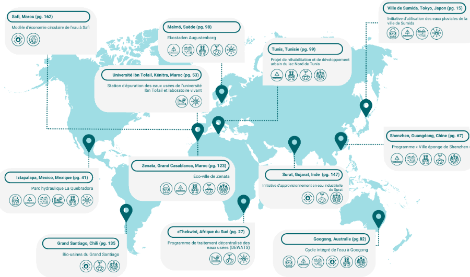
Chapter 1 : Decentralised, local and participatory systems
Small-scale, community-based solutions that demonstrate how decentralisation can promote circularity whilst strengthening social inclusion. Notable examples include :
-
Sumida (Japan) : A neighbourhood-scale rainwater harvesting network, linked to natural disaster preparedness and civic engagement.
-
eThekwini (South Africa) : DEWATS (decentralised wastewater treatment) systems in informal settlements, combining sanitation, water reuse and energy generation.
-
La Quebradora (Mexico): A multi-purpose park combining flood management, water harvesting and environmental education.
-
Kenitra (Morocco): A university-run wastewater treatment plant where treated wastewater is reused for the irrigation of green spaces.
Chapter 2 : Urban Integration and Regenerative Planning
This chapter highlights projects in which water becomes a key element of urban planning, contributing to ecological regeneration and the creation of sustainable public spaces. Among the flagship initiatives :
-
Shenzhen (China) : The ‘Sponge City’ programme, which incorporates wetlands, canals and infiltration systems to enhance flood resilience.
-
Googong (Australia) : A fully integrated water cycle in a new town, utilising dual networks and rainwater harvesting.
-
Malmö (Sweden) : The Augustenborg eco-neighbourhood, redeveloped with green roofs and open stormwater management systems.
-
Tunis (Tunisia) : The rehabilitation of North Lake, transforming a degraded lagoon into a hub for sustainable urban development.
-
Zenata (Morocco) : An eco-city where green and blue corridors promote groundwater recharge and climate resilience.
Chapter 3 : Centralised circular systems and resource recovery
This chapter explores large-scale solutions, where water reuse and resource recovery become drivers of industrial and urban development. Examples include :
-
Greater Santiago (Chile) : Bio-plants that convert wastewater into energy, clean water and agricultural by-products.
-
Surat (India) : A partnership between public utilities and industry to channel treated wastewater to textile factories, thereby conserving fresh water.
-
Safi (Morocco) : A circular model combining seawater desalination and wastewater reuse in the phosphate industry.
Lessons for Moroccan cities : concrete avenues for action
The case studies presented in this collection offer valuable lessons for Moroccan cities, which face similar challenges in terms of water stress, rapid urbanisation and climate vulnerability. Here are the key takeaways :
-
Act early and integrate water planning from the design stage of urban projects : Integrating circular strategies – wastewater reuse, green and blue infrastructure, nature-based solutions, rainwater harvesting, redundant networks – helps avoid costly retrofits and reduces pressure on centralised infrastructure. Developing cities, such as Zenata and Safi, demonstrate how early planning can turn challenges into opportunities.
-
Create enabling regulatory environments : All the success stories featured in this compendium were underpinned by clear mandates, strict standards (for example, for redundant networks) and institutional support that reduced investment risks. In Morocco, where regulatory frameworks are still under development, this lesson is particularly relevant for encouraging the adoption of innovative solutions.
-
Promoting private investment under public oversight : Many projects, such as those in Googong (Australia), Zenata (Morocco) and Safi (Morocco), were funded by developers or industry under negotiated agreements, whilst public authorities took responsibility for long-term operation or oversight. This public-private partnership (PPP) model can be replicated in Morocco to mobilise additional resources and accelerate the implementation of circular economy projects.
-
Prioritise communication and education : Public acceptance of reuse systems depends on clear communication, the involvement of schools and the visibility of the infrastructure. The examples of Googong, Sumida and Santiago show how effective awareness-raising can overcome reluctance and encourage the adoption of new practices.
-
Design to achieve multiple co-benefits : Combining water reuse with green spaces, urban cooling or education helps to justify investments and increase their impact. Projects such as La Quebradora (Mexico), Augustenborg (Sweden) and Zenata (Morocco) illustrate how water infrastructure can also improve quality of life and strengthen social cohesion.
-
Investing in local capacity : Local authorities and public services that have invested in staff training, stakeholder engagement and institutional learning have been more successful in implementing their projects. The examples of Googong, eThekwini and Santiago highlight the importance of strengthening local skills to ensure the sustainability of initiatives.
Taken together, these lessons show that circular urban water management systems are not only technically feasible, but can also be economically viable and socially accepted, provided they are supported by rigorous planning, inclusive governance and appropriate funding frameworks. For Moroccan cities, particularly those undergoing development or densification, this compendium serves as a practical resource to guide their future investments in water resilience.
Recommendations for Moroccan decision-makers: towards sustainable water management
To put these lessons into practice, Moroccan decision-makers – whether local elected representatives, public service officials or private-sector stakeholders – can draw on the following courses of action:
-
Strengthen legal and regulatory frameworks : Adopt local by-laws to encourage rainwater harvesting, as the city of Sumida in Japan has done, or impose green building standards for new urban projects. These measures will help create an environment conducive to innovation and investment in circular infrastructure.
-
Invest in green and blue infrastructure : Systematically incorporate green corridors, retention basins and green roofs into urban development projects. Examples from Malmö (Sweden) and Shenzhen (China) demonstrate how such infrastructure can simultaneously mitigate flood risks, recharge groundwater aquifers and improve the quality of life.
-
Promote public-private partnerships (PPPs) : Encourage collaboration between public and private sector stakeholders to finance and operate circular water management projects. The models implemented in Safi (Morocco) and Surat (India) demonstrate that these partnerships can reduce costs, speed up implementation and ensure the sustainable management of infrastructure.
-
Raise awareness and educate citizens : Organise awareness-raising campaigns, participatory workshops and site visits to involve local residents in water management. Initiatives in Sumida (Japan) and La Quebradora (Mexico) show that social acceptance is a key factor for success.
-
Train local stakeholders and strengthen institutional capacity : Invest in training technicians, engineers and managers to ensure the operation and maintenance of circular infrastructure. Examples from eThekwini (South Africa) and Kenitra (Morocco) highlight the importance of local expertise in ensuring the long-term viability of projects.
-
Encouraging innovation and research : Supporting living labs, such as the one at Ibn Tofail University in Kenitra, where students, researchers and professionals can test new technologies and share their knowledge. These platforms foster the emergence of solutions tailored to local contexts.
1 The data for the case studies were collected through desk research and via ICLEI’s global network of partners, local authorities and experts, with direct consultations carried out for certain selected cases. The literature review consisted of a systematic examination and analysis of grey literature, academic articles, official reports and documents, and project-related documents. For some cases, this review was supplemented by direct consultations with stakeholders actively involved in the initiatives. For other cases, ICLEI’s local offices working with the relevant local authorities were consulted to ensure the accuracy, contextual relevance and completeness of the information. In cases where there was a wealth of literature and where ICLEI had no direct contact with the project or the local authorities, the literature review alone was deemed sufficient.
Sources
Online document : Gestion circulaire et résiliente de l’eau en milieu urbain - Circular and resilient water management in urban areas
To go further
Websites : iclei.org/ & iclei-europe.org/
Bibliography
1. African Development Bank. (2024). Morocco – Project to digitise, boost production and improve the performance of the drinking water sector (PDRAP) – Project evaluation report. www.afdb.org/sites/default/files/documents/projects-and-operations/morocco_-_drinking_water_digitisation_pdrap_par_final_-_eng1.pdf
2. Akhannouch, A. (2023). The Head of Government presides over the signing ceremony for a memorandum of understanding and a concession contract between the government and OCP on the production of drinking water through seawater desalination in Safi and El Jadida. Head of Government – Kingdom of Morocco.www.cg.gov.ma/en/node/11313
3. Atalayar. (28 August 2023). The Safi desalination plant comes into service. www.atalayar.com/en/articulo/society/the-safi-desalination-plant-comes-into-operation/20230828132658190036.html
4. Climates to Travel. (n.d.). Safi, Morocco climate. Climates to Travel.www.climatestotravel.com/climate/morocco/safi
5. Elair, C., Chaham, K. R., & Hadri, A. (2023). Assessment of drought variability in the Marrakech-Safi region (Morocco) at different time scales using GIS and remote sensing. Water Science and Technology: Water Supply. IWA Publishing. doi.org/10.2166/ws.2023.283
6. European Bank for Reconstruction and Development (EBRD) (May 2024). Stakeholder Engagement Plan. Project for the modular seawater desalination plant in Safi by the Office Chérifien des Phosphates. www.ebrd.com/home/work-with-us/projects/psd/54662.html
7. GMT MAROC. (21 December 2023). The start of production for the desalination plant in the city of Safi [Start of production at the desalination plant in the city of Safi]. gmtmaroc.com/en/the-start-of-production-for-the-desalination-plant-in-the-city-of-safi/
8. Minoubi, A., Mejjad, N., El Khalidi, K., Bouchkara, M., Fadili, A., Chaibi, M., & Zourarah, B. (2023). Spatial distribution and assessment of the level of contamination in marine sediments in Safi Bay (Moroccan Atlantic coast). Oceans, 4(4), 347–361. www.mdpi.com/2673-1924/4/4/239. Novo, C. (26 March 2024). Desalination in Morocco: meeting water needs in a region where water is scarce. Smart Water Magazine. smartwatermagazine.com/news/smart-water-magazine/desalination-morocco-meeting-water-demands-a-water-scarce-region
10. Pumps Africa. (17 December 2021). Construction begins on the Safi wastewater treatment plant in Morocco. pumps-africa.com/construction-of-safi-wastewater-treatment-in-morocco-begins/
11. Rahhou, J. (26 August 2024). Safi, in Morocco, sources 100 per cent of its drinking water from a desalination plant. Barlaman Today. barlamantoday.com/2024/08/26/safi-in-morocco-sources-100-of-drinking-water-from-desalination-plant/
12. Zenata Development Company (2014). Environmental, human and socio-economic impact assessment. Development project for the new town of ZENATA. Non-technical summary. www.ebrd.com/home/work-with-us/projects/psd/54662.html