Circular water economy model in Safi (Morocco)
Circular and resilient water management in urban areas
August 2025
ICLEI-Local Governments for Sustainability
In Safi, the Office Chérifien des Phosphates (OCP) has implemented a circular water management model, combining seawater desalination and wastewater reuse to secure the resources needed for phosphate mining, whilst reducing the environmental impact.
This project, carried out in collaboration with local stakeholders, demonstrates how heavy industry can adopt sustainable practices to conserve natural resources and support local development.
Driven by an integrated vision, this project illustrates how industrial innovation can address water and environmental challenges.
This factsheet summarises one of the 12 case studies in the document: Circular and Resilient Water Management in Urban Areas
Safi, a coastal town in Morocco, is a major industrial centre, particularly for phosphate mining. With a population of around 300,000, the town faces extreme water stress, industrial pollution and an urgent need for sustainable solutions to reconcile economic development with the conservation of natural resources. In a semi-arid climate (limited rainfall, hot summers), Safi must find ways to secure its water supply whilst reducing its environmental impact. The Office Chérifien des Phosphates (OCP), a key player in the local economy, plays a central role in the search for innovative solutions.
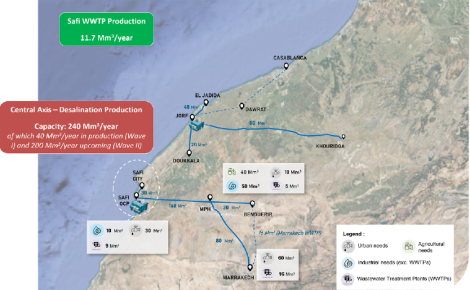
The circular water economy model in Safi, implemented by the OCP, combines seawater desalination and wastewater reuse to secure the resources needed for phosphate mining, whilst reducing the environmental impact. This project, carried out in collaboration with the Safi Inter-municipal Autonomous Water and Electricity Distribution Authority (RADEES) and the Marrakech-Safi Regional Multi-service Company (SRM-MS), demonstrates how heavy industry can adopt sustainable practices to conserve natural resources and support local development.
Solutions implemented
-
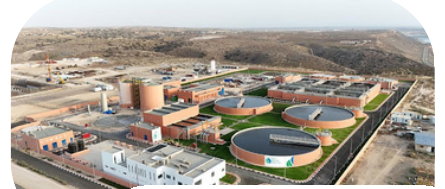
Seawater desalination: Production of fresh water for industrial use, thereby reducing dependence on limited fresh water resources.
-
Wastewater reuse : Treatment and reuse in industrial processes, such as cooling or ore washing.
-
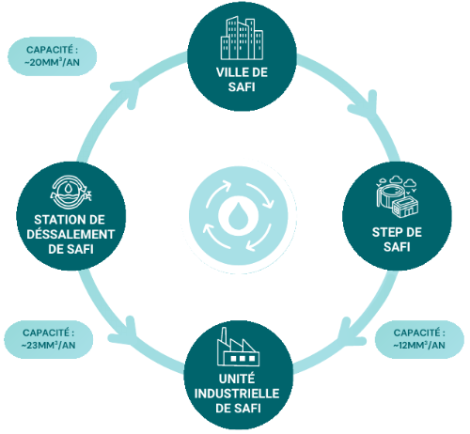
Circular industrial ecosystem : Integration of water, energy and material flows to minimise waste and maximise resource efficiency.
-
Collaboration with local stakeholders : Involvement of local authorities, businesses and civil society to ensure sustainable and inclusive management.
Key results
-
50 per cent reduction in freshwater consumption through desalination and wastewater reuse, thereby improving the region’s water security.
-
A 30 per cent reduction in the carbon footprint associated with phosphate mining, achieved through process optimisation and waste reduction.
-
Creation of a replicable model for other industrial sites in Morocco and across Africa, demonstrating how industry can become a driving force for sustainability.
-
Improved water resilience in the region, supporting both industry and local communities.
Climate and environmental impacts
-
Climate change mitigation :
-Seawater desalination reduces pressure on freshwater resources, but requires energy optimisation to limit CO₂ emissions.
-Wastewater reuse reduces the need to pump and treat freshwater, an energy-intensive process.
-Integrating water, energy and material flows into a circular ecosystem minimises waste and improves resource efficiency.
-
Climate adaptation and resilience :
-Water security : The combination of desalination and reuse improves water availability for industry, thereby reducing vulnerability to water shortages.
-Wastewater management : Treatment and reuse reduce the risk of pollution to watercourses and groundwater.
-
Biodiversity and water quality : Reducing discharges of untreated wastewater improves the quality of aquatic ecosystems, thereby protecting biodiversity and public health.
Success factors
-
Values :
- Recognition of the need to preserve natural resources in a context of scarcity.
- Integration of sustainability and the circular economy into industrial processes.
-
Connections :
- Physical connections : Desalination and water reuse infrastructure is integrated into the industrial ecosystem, creating a coherent system for water management.
- Social connections : Collaboration between OCP, local authorities, businesses and civil society to design solutions tailored to local needs.
-
Investments :
- Funding from the OCP : The project has received significant financial support from the OCP as part of its sustainability strategy.
- Local partnerships : Collaboration with RADEES and SRM-MS to ensure sustainable resource management.
Replicability for Morocco
The Safi model could inspire other industrial sites in Morocco, such as those at Jorf Lasfar or Khouribga, where circular water management could reduce pressure on natural resources and improve business competitiveness. By combining desalination, reuse and local collaboration, this project demonstrates how industry can become a driving force for sustainability and climate resilience.
For example, in Jorf Lasfar, where the chemical industry is a key sector, adopting this model would help secure the water supply whilst reducing the environmental impact. Similarly, in mining areas, such as Khouribga, this system could help manage water resources sustainably, whilst supporting the region’s economic development.
Sources
Online document, see pages 162 to 172 : Gestion circulaire et résiliente de l’eau en milieu urbain - Circular and resilient water management in urban areas
To go further
Websites : iclei.org/ & iclei-europe.org/
Bibliography
1. Banque africaine de développement. (2024). Maroc – Projet de digitalisation, de renforcement de la production et d’amélioration de la performance de l’eau potable (PDRAP) – Rapport d’évaluation du projet. www.afdb.org/sites/default/files/documents/projects-and-operations/morocco_-_drinking_water_digitisation_pdrap_par_final_-_eng1.pdf
2. Akhannouch, A. (2023). Le chef du gouvernement préside la cérémonie de signature d’un protocole d’accord et d’un contrat de concession entre le gouvernement et OCP sur la production d’eau potable par dessalement de l’eau de mer à Safi et El Jadida. Chef du gouvernement - Royaume du Maroc. www.cg.gov.ma/en/node/11313
3. Atalayar. (28 août 2023). La station de dessalement de Safi entre en service. www.atalayar.com/en/articulo/society/the-safi-desalination-plant-comes-into-operation/20230828132658190036.html
4. Climates to Travel. (s.d.). Safi, Morocco climate. Climates to Travel. www.climatestotravel.com/climate/morocco/safi
5. Elair, C., Chaham, K. R., & Hadri, A. (2023). Évaluation de la variabilité de la sécheresse dans la région de Marrakech-Safi (Maroc) à différentes échelles de temps à l’aide de SIG et de la télédétection. Science et technologie de l’eau : approvisionnement en eau. IWA Publishing. doi.org/10.2166/ws.2023.2836. Banque européenne pour la reconstruction et le développement (BERD) (mai 2024). Plan d’engagement des parties prenantes. Projet de la station modulaire de dessalement des eaux de mer à Safi par l’Office Chérifien des Phosphates. www.ebrd.com/home/work-with-us/projects/psd/54662.html
7. GMT MAROC. (21 décembre 2023). The start of production for the desalination plant in the city of Safi [Début de la production de l’usine de dessalement de la ville de Safi]. gmtmaroc.com/en/the-start-of-production-for-the-desalination-plant-in-the-city-of-safi/
8. Minoubi, A., Mejjad, N., El Khalidi, K., Bouchkara, M., Fadili, A., Chaibi, M., & Zourarah, B. (2023). Répartition spatiale et évaluation du niveau de contamination des sédiments marins de la baie de Safi (côte atlantique marocaine). Oceans, 4(4), 347–361. www.mdpi.com/2673-1924/4/4/23
9. Novo, C. (26 mars 2024). Le dessalement au Maroc : répondre aux besoins en eau dans une région où l’eau est rare. Smart Water Magazine. smartwatermagazine.com/news/smart-water-magazine/desalination-morocco-meeting-water-demands-a-water-scarce-region
10. Pumps Africa. (17 décembre 2021). Début de la construction de la station d’épuration des eaux usées de Safi au Maroc. pumps-africa.com/construction-of-safi-wastewater-treatment-in-morocco-begins/
11. Rahhou, J. (26 août 2024). Safi, au Maroc, tire 100 % de son eau potable d’une usine de dessalement. Barlaman Today. barlamantoday.com/2024/08/26/safi-in-morocco-sources-100-of-drinking-water-from-desalination-plant/
12. Société d’Aménagement de Zenata (2014). Étude d’impact sur l’environnement naturel, humain et socio-économique. Projet d’aménagement de la ville nouvelle de ZENATA. Résumé non technique. www.ebrd.com/home/work-with-us/projects/psd/54662.html
13. Walaw. (27 août 2024). La solution de Safi pour l’eau de mer : une usine de dessalement innovante pour lutter contre la pénurie d’eau. 13. GMT MAROC. (2023, December 21). The start of production for the desalination plant in the city of Safi. gmtmaroc.com/en/the-start-of-production-for-the-desalination-plant-in-the-city-of-safi/
14. Contributeurs Wikipédia. (s.d.). Safi, Maroc. Dans Wikipédia, l’encyclopédie libre. en.wikipedia.org/wiki/Safi,_Morocco
15. World Population Review. (s.d.). Population de Safi, Maroc. World Population Review. worldpopulationreview.com/cities/morocco/safi
16. Zgheib, N. (18 novembre 2024). La BERD stimule le dessalement de l’eau à des fins industrielles au Maroc. Banque européenne pour la reconstruction et le développement. www.ebrd.com/home/news-and-events/news/2024/ebrd-boosts-water-desalination-for-industrial-use-in-morocco.html