Augustenborg Eco-neighbourhood in Malmö (Sweden)
Circular and resilient water management in urban areas
August 2025
ICLEI-Local Governments for Sustainability
In the Augustenborg eco-neighbourhood in Malmö, Sweden, an ambitious urban regeneration project has transformed a run-down neighbourhood into a model of water resilience and environmental sustainability.
Through green roofs, open stormwater management systems and biodiversity corridors, this project demonstrates how urban regeneration can incorporate circular water management to create green, resilient and inclusive spaces.
Driven by a collaboration between the local council, experts and residents, this neighbourhood has become a benchmark for sustainable urban development and citizen participation.
This factsheet summarises one of the 12 case studies in the document: Circular and Resilient Water Management in Urban Areas
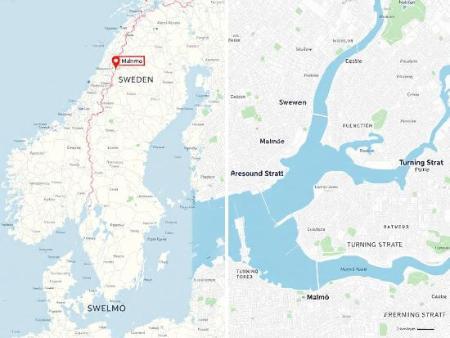
Augustenborg is a neighbourhood in Malmö, Sweden, with a population of around 2,000. In the 1990s, the neighbourhood was known for its social and environmental problems, including recurrent urban flooding, stormwater pollution and a lack of green spaces. Malmö City Council decided to regenerate it into a model eco-neighbourhood, combining water resilience, environmental sustainability and quality of life. With a temperate oceanic climate (regular rainfall), the neighbourhood needed to find solutions to manage stormwater sustainably, whilst improving the living environment for its residents.
The Augustenborg regeneration project has transformed this neighbourhood into a model of circular water management by incorporating green roofs, open stormwater management systems and biodiversity corridors. Carried out in the 2000s, this project aims to create a green, resilient and inclusive neighbourhood where water is managed in a natural and sustainable way. The aim was to reduce the risk of flooding, improve water quality and create public spaces for residents.
Solutions implemented
-
Green roofs : Installed on public and private buildings to absorb rainwater, improve thermal insulation and reduce the urban heat island effect. These roofs also contribute to biodiversity by providing habitats for flora and fauna.
-
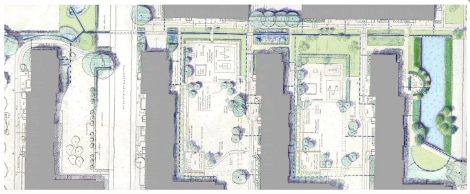
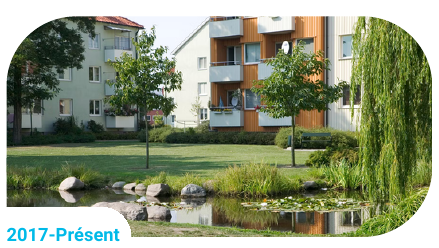
Open stormwater management systems : Retention basins and channels designed to store and infiltrate rainwater, thereby reducing surface runoff and the risk of flooding.
-
Biodiversity corridors : Connected green spaces to facilitate wildlife movement and improve ecological connectivity within the neighbourhood.
-
Citizen participation : Involving residents in the design and management of green spaces, thereby strengthening their sense of ownership and the project’s sustainability.
Key results
-
A 50 per cent reduction in rainwater runoff, thereby limiting the risk of flooding in the neighbourhood.
-
Improved biodiversity : Green roofs and biodiversity corridors have encouraged the return of local species and the creation of a resilient urban ecosystem.
-
Reduction in the urban heat island effect : Thanks to green roofs and green spaces, local temperatures have been lowered, thereby improving thermal comfort for residents.
-
Model for urban regeneration : The project’s success has inspired other neighbourhoods in Sweden and internationally, demonstrating how urban regeneration can incorporate sustainable water management.
Climate and environmental impacts
-
Climate change mitigation :
- Green roofs and green spaces help to reduce the urban heat island effect, thereby lowering energy consumption associated with air conditioning.
- Local stormwater management reduces the need to pump and transport water over long distances, an energy-intensive operation.
-
Climate adaptation and resilience :
- Stormwater management : Retention basins and open systems help to better withstand extreme weather events, such as heavy rainfall or prolonged droughts.
- Flood reduction : Green infrastructure acts as a natural buffer, absorbing excess water and thereby reducing the risk of flooding.
-
Biodiversity : Green roofs and biodiversity corridors provide habitats for a diverse range of flora and fauna, contributing to the restoration of urban ecosystems.
Success factors
-
Values :
- An integrated approach combining water resilience, biodiversity and quality of life.
- Recognition of the importance of community participation in ensuring the project’s sustainability.
-
Connections :
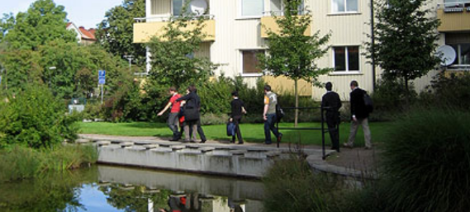
- Physical connections : Green infrastructure (roofs, ponds, corridors) is integrated into the existing urban fabric, creating a coherent network for stormwater management.
- Social connections : Collaboration between the local authority, urban planners, environmental experts and residents to design solutions tailored to local needs.
-
Investments :
- Public funding : The project received significant municipal support as part of local sustainable development policies.
- Grants for green infrastructure : Financial incentives were offered to encourage the adoption of green roofs and other sustainable solutions.
Replicability in Morocco
The Augustenborg model could inspire neighbourhoods undergoing regeneration in Morocco, such as in Casablanca or Fez, where ageing infrastructure and flood risks call for innovative solutions. The integration of green roofs, retention basins and ecological corridors would help improve climate resilience and the quality of urban life.
For example, in Casablanca, where urban flooding is a recurring problem, adopting this model could help reduce risks whilst creating green spaces for residents. Similarly, in historic areas, such as the medina of Fez, green roofs could help manage rainwater whilst improving the living environment and preserving the architectural heritage.
Sources
Online document, see pages 98 to 111 : Gestion circulaire et résiliente de l’eau en milieu urbain - Circular and resilient water management in urban areas
To go further
Websites : iclei.org/ & iclei-europe.org/
Bibliography
1. Baldrich Architects. (18 juin 2018). Green-house Living. Malmö. www.rb-aa.com/green-house-living/
2. Boverket. (n.d.). Ekostaden Augustenborg. www.boverket.se/sv/samhallsplanering/arkitektur-och-gestaltad-livsmiljo/natverk-och-samarbeten/nordiskt-samarbete/stadsgronska/exempel/ekostaden/
3. Brink, E. (29 août 2018). Les citoyens suédois ont besoin de plus de soutien pour faire face aux effets du changement climatique. Centre d’études sur la durabilité de l’université de Lund. www.lucsus.lu.se/article/swedish-citizens-need-more-support-handle-effects-climate-change
4. Agence européenne pour l’environnement. (27 juin 2017). Gestion des eaux pluviales urbaines à Augustenborg, Malmö. Climate-ADAPT. climate-adapt.eea.europa.eu/en/metadata/case-studies/urban-storm-water-management-in-augustenborg-malmo
5. Forest Research. (s.d.). Systèmes de drainage durables à Malmö, en Suède. Un nouveau système de gestion des eaux pluviales à Ekostaden Augustenbourg, Malmö. Forest Research.cdn.forestresearch.gov.uk/2022/02/urgp_case_study_015_malmo-2.pdf
6. Greenroofs.com. (n.d.). Jardin botanique sur le toit d’Augustenborg. Extrait de www.greenroofs.com/projects/augustenborg-botanical-roof-garden/
7. Interlace Hub. (n.d.). Facteur d’espaces verts et système de points verts – Malmö. interlace-hub.com/green-space-factor-and-green-points-system-malmö
8. Kazmierczak, A., & Carter, J. (2010). Adaptation au changement climatique grâce à des infrastructures vertes et bleues – Augustenborg, Malmö. Agence européenne pour l’environnement. copenhagenwater.wordpress.com/wp-content/uploads/2013/11/adaption-to-climate-change-using-green-and-blue-infrastructure-augustenborg-malmo.pdf
9. Kruuse, A. (2021). The Green Space Factor and the Green Points System [Le facteur espace vert et le système de points verts] (GRaBS Expert Paper 6). Association pour l’aménagement du territoire et de l’urbanisme. tcpa.org.uk/wp-content/uploads/2021/11/EP6_FINAL.pdf
10. Malmö Stad. (n.d.). Ekostaden Augustenborg (Eco-City). malmo.se/Welcome-to-Malmo/Technical-visits/Theme-Sustainable-City/-Ecology-Energy-and-Climate/-Ekostaden-Augustenborg-Eco-City.html
11. Malmö Stad. (n.d.). Faits et statistiques : Population. malmo.se/Facts-and-statistics/Population.html
12. Metropolis. (n.d.). Ekostaden Augustenborg and Bo01 – City of Tomorrow [La ville de demain]. use.metropolis.org/case-studies/city-of-tomorrow
13. Mobini, S., Nilsson, E., Persson, A., Becker, P., & Larsson, R. (2021). Analysis of pluvial flood damage costs in residential buildings – A case study in Malmö [Analyse des coûts des dommages causés par les inondations pluviales dans les bâtiments résidentiels – Une étude de cas à Malmö]. International Journal of Disaster Risk Reduction, 62, Article 102407. doi.org/10.1016/j.ijdrr.2021.102407
14. Monika Månsson and Bengt Persson. (2021, March). The Eco-city Augustenborg – experiences and lessons learned [L’éco-ville d’Augustenborg – expériences et enseignements tirés]. www.diva-portal.org/smash/get/diva2:1571677/FULLTEXT01.pdf
15. Mottaghi, M. (2020). Map of Augustenborg showing blue-green solutions in public open spaces. In Blue-Green Playscapes: Exploring Children’s Places in Stormwater Spaces in Augustenborg, Malmö [Carte d’Augustenborg montrant les solutions bleues-vertes dans les espaces publics ouverts]. Urban Planning, 6(2),175–188. doi.org/10.17645/up.v6i2.3953
16. Ponsford, M. (2021, February 5). Swede dreams: can Malmö’s green points system help rewild London? [Rêves suédois : le système de points verts de Malmö peut-il aider à renaturer Londres ?] The Guardian. www.theguardian.com/environment/2021/feb/05/malmo-sweden-success-rewild-london-aoe
17. Rolfsdotter-Jansson, C. (n.d.). Ekostaden Augustenborg – Towards a sustainable neighbourhood [Vers un quartier durable]. Extrait de www.rolfsdotter.se/pdf/Ecocity_Aug.pdf
18. Schott, A. B. S., Nilsson, M. O., & Hall, J. (2013, October 3). Ekostaden Augustenborg vill bli bäst på biologisk mångfald [La ville écologique d’Augustenborg veut devenir la meilleure en matière de biodiversité]. MKB Fastighets AB. www.mynewsdesk.com/se/mkb_fastighets_ab/pressreleases/ekostaden-augustenborg-vill-bli-baest-paa-biologisk-maangfald-912523
19. Urban Nature Atlas. (2022, April). Eco City Augustenborg. una.city/nbs/malmo/eco-city-augustenborg
20. World Habitat Awards. (n.d.). Ekostaden Augustenborg. World Habitat. world‐habitat.org/world‐habitat‐awards/winners‐and‐finalists/ekostaden‐augustenborg/
21. World Habitat. (2011). Eco‐city Augustenborg, Sweden: Peer‐exchange and analysis [Suède : échange entre pairs et analyse] [PDF]. www.world-habitat.org/wp-content/uploads/2016/03/Report-Eco-city-Augustenborg-peer-exchange-5MB1.pdf