Encouraging residents without gardens to use wheeled compost bins. The Gisors experience
5 pilot schemes to promote the sorting of bio-waste at source
June 2026
Agence pour l’Environnement et la Maîtrise de l’Energie (ADEME)
In urban areas, where few residents have gardens, a lot of organic waste ends up in the general household waste bin. This poses a challenge for local authorities.
In Gisors, an urban town in the Eure department, Sygom has installed wheeled compost bins in the town centre. An information campaign for users was launched as soon as the bins were installed to maximise residents’ uptake of the scheme.
To download : 2026_06__guide_concertation_biodechets_fr.pdf (5 MiB)
Diagnosis
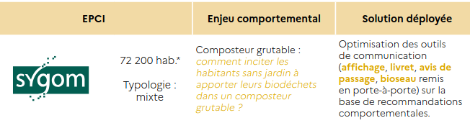
To assess the uptake and anticipate the use of hoistable compost bins, around thirty households in the town centre were surveyed. Favourable to the installation of communal compost bins at the foot of their blocks of flats and possessing a basic understanding of sorting guidelines, they expressed two expectations regarding the location of the compost bins :
-
not too close, for fear of nuisance caused by odours or rats ;
-
not too far away, so that they can access them without difficulty.
A number of barriers to adopting the new waste sorting practices were also identified. As some households do not speak French, their understanding of certain sorting guidelines may be limited. For others, it is the act of sorting itself that attracts little interest due to a perceived limited impact. Although residents’ feedback relates to stated intentions rather than observed facts, it highlights two key conditions for success :
-
the provision and accessibility of facilities ;
-
the importance of giving meaning to the act of sorting to encourage buy-in by emphasising its benefit to the community.
Solution developed
Several communication tools were designed to encourage residents to deposit organic waste in the wheelie bin-style composters :
-
installation of information boards near the future locations of the composters to announce their arrival ;
-
the production of a booklet on composting and a sorting guide, distributed door-to-door to residents, along with a compost bin (a delivery notice is left if residents are absent, inviting them to collect their kit at a later date).
| “ The most useful aspect was the discussions with other local authorities. […] This kind of support is extremely valuable because it helps us come up with ideas we wouldn’t have thought of otherwise. ” |
Results
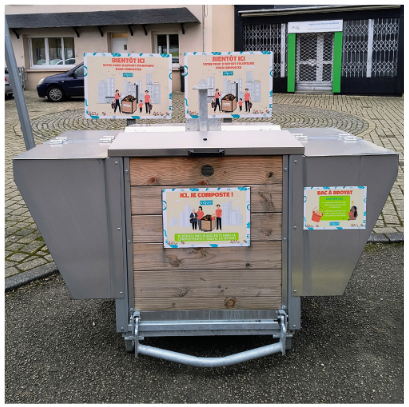
Following discussions with the local authority and ADEME Normandy, it was agreed to focus support on optimising the communication tools planned to support the roll-out of the compost bins.
To this end, the consultancy firm in charge produced a document containing targeted recommendations to refine the various materials before their distribution, with a view to enhancing their impact and preparing for the potential wider roll-out of the scheme.
Points to bear in mind
Do not produce too many communication materials :
-
one communication objective per material, ideally tailored to a specific audience ;
-
Before publishing, consider the actual added value of the material compared to what already exists.
Keep it simple :
-
presenting instructions as simple, practical steps (“I collect my Monkit ”, “I empty my organic waste bin ”, “I add shredded organic waste ”) makes the action clearer and easier to carry out ;
-
avoid unnecessary steps and reduce friction, for example by allowing residents to collect their organic waste bin without having to present the collection notice.
Provide meaning and motivate action :
-
link the recommended actions to tangible benefits for residents (rather than simply promoting the production of ‘high-quality compost ’, explain how they will benefit from it or describe how the local authority will use it) ;
-
communicate by emphasising the benefits for the user (“to improve the quality of your compost”) rather than highlighting risks (“to prevent rodents in the composter”…)
Sources
Extract: the experience of Gisors, pages 16–17
To go further
-
SYGOM (SYndicat de Gestion des Ordures Ménagères du Nord et de l’Est du département de l’Eure), a public inter-municipal cooperation body (EPCI) located in the Normandy region. Its area of operation covers the departments of Eure and Seine-Maritime. Since its creation on 1 January 2001, SYGOM has been responsible for the following two areas of activity: the collection and treatment of household and similar waste.
At SYGOM
-
Natalia Catherine, Head of the Technical Division: n.catherine[@]sygom.fr
-
Émeline Thomas, Head of Collection and Sorting: e.thomas[@]sygom.fr
-
Ludovic Botté, Environmental Coordinator in charge of bio-waste: l.botte[@]sygom.fr