Reintroducing new waste sorting guidelines: the experience of the municipality of Fontaine-la-Mallet
5 pilot schemes to promote the sorting of bio-waste at source
June 2026
Agence pour l’Environnement et la Maîtrise de l’Energie (ADEME)
Since March 2024, the municipality of Fontaine-la-Mallet has introduced a new waste sorting guideline: food waste must now be placed in the brown bins, which were previously reserved for green waste only. However, council staff observed that residents were only placing green waste in these bins. This led them to consider the reasons hindering the sorting of food waste and to test solutions to encourage residents to adopt the new sorting guidelines.
To download : 2026_06__guide_concertation_biodechets_fr.pdf (5 MiB)
Findings
The project team carried out around thirty interviews, both door-to-door and at the local market. Many residents said they were unaware of the new sorting guidelines (only 15 per cent of the brown bins had been fitted with explanatory stickers). Nearly half said they had their own compost bin, which was why they were not using the brown bin for food waste (whereas meat waste, for example, is not put in the compost bin and could be disposed of in the brown bin).
Solution developed
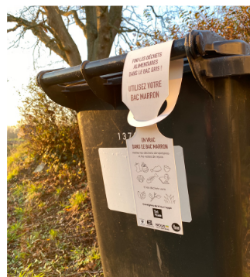
The project team wanted to engage with users once again. They designed a label to be attached to residual household waste bins by refuse collectors during collection, with several objectives :
-
To communicate at the right moment, when residents are putting out their rubbish, interrupting a routine directly linked to the targeted behaviour, in order to introduce the new guidance ;
-
To make the message stand out, using a display method that attracts attention in a routine setting;
-
To use a universal point of contact: the household waste bin ensures wide reach, including among households that do not yet have a brown bin, or that do not put their bin out systematically;
-
Formulate a clear and motivating call to action with a simple message, illustrated by pictograms, which reduces ambiguity regarding sorting guidelines and boosts motivation by explaining the concrete impact of the action (explanations on the recovery of collected bio-waste).
Results
As the sole source of information on how to dispose of the bio-waste bag, the label achieved its aim, with 27 out of the 33 residents surveyed recalling the messages conveyed and stating that they appreciated this communication.
Impact on the intention to sort : around half of those surveyed indicated that they were already aware of the new sorting guidelines and were placing their bio-waste in the brown bin. Among those who had not yet adopted the sorting system, two-thirds indicated that they had changed their practices following the initiative, with the main triggers being :
-
the clarity of the guidelines ;
-
the fact that the organic waste bin was free of charge;
-
knowing where the compost was going, which was seen as an incentive.
Those who had not changed their practices felt that their individual compost bin was sufficient or were concerned about pests.
In summary
The initiative helped to improve residents’ understanding of the scheme. It also highlighted several ways to optimise the uptake of the waste sorting guidelines.
Further measures, such as distributing additional compost bins or raising greater awareness of the concerns regarding pests, could be considered.
Extending visual communication to other media, such as posters in public spaces, could enhance the message’s effectiveness.
Points to bear in mind
Anticipate certain time-consuming processes :
-
Number of man-days required for interviews ;
-
Processes for creating and approving materials (3 weeks in this case) ;
-
Printing (12 to 15 working days).
Leverage existing resources :
-
Waste sorting ambassadors, already in place within the Metropolitan Area ;
-
Waste collection contractor, whose contractual obligations include a prevention mandate.
Sources
ADEME document : Accompagner le changement pour le tri à la source des biodéchets : L’exemple de 5 collectivités Normandes (Supporting the transition to source separation of bio-waste: The example of five local authorities in Normandy] (in French))
Excerpt: the experience of the municipality of Fontaine-la-Mallet, pages 8–9
To go further
At Le Havre Seine Métropole
-
Anne-Laure Hess, Head of the Prevention, Reuse and Information Department at Le Havre Seine Métropole : anne-laure.hess[@]lehavremetro.fr
-
Laura Lesage, Project Manager for Bio-waste Management at Le Havre Seine Métropole : laura.lesage[@]lehavremetro.f