Shared compost bin: engaging residents in block-of-flats. The Flers experience
5 pilot schemes to promote the sorting of bio-waste at source
June 2026
Agence pour l’Environnement et la Maîtrise de l’Energie (ADEME)
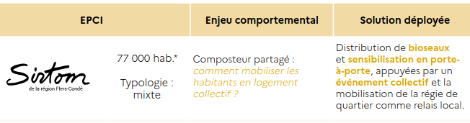
In a neighbourhood of Flers, communal compost bins were installed in March 2024. Six months later, it was found that residents were not making sufficient use of this waste sorting solution and that the bins were being misused, with bags of household waste being left there or fly-tipping taking place. The local authority wishes to identify the barriers to the proper use of the shared compost bins and to test solutions to encourage their use.
To download : 2026_06__guide_concertation_biodechets_fr.pdf (5 MiB)
Diagnosis
The project group carried out a study comprising a one-off observation of a compost bin by a staff member, a focus group with 15 local residents recruited via the neighbourhood council and a leaflet, and interviews with an elected representative, the neighbourhood council and the social housing provider. The study revealed several practical and informational barriers to the use of the shared compost bin :
-
space constraints in block-of-flats and the lack of a bio-bin hinder the implementation of waste sorting ;
-
a lack of awareness of sorting guidelines : one-third of those interviewed were unaware of the sorting guide produced by the local authority, whilst others – who had difficulty understanding French – struggled with the instructions ;
-
low motivation to sort waste, partly due to a lack of understanding of the waste treatment process (some residents believe that household waste is sorted by the local authority after collection, which reduces their inclination to take action themselves).
Solution developed
Following the assessment, the project team developed its intervention strategy, which included the distribution of 50 organic waste bins and raising awareness of the sorting guidelines.
Three distribution methods were implemented :
-
door-to-door, with an explanatory handover and assistance in placing the organic waste bin in the best location within the home ;
-
at a compost bin launch event ;
-
during distribution sessions organised via the neighbourhood council.
| “ We thought it was enough simply to provide users with information so that they would start sorting their waste. Supporting behavioural change made us realise that it didn’t work like that. ” |
In particular, the project team wanted to :
-
capitalise on a moment of change brought about by the recent requirement to use transparent bags for household waste ;
-
to humanise the organisation and highlight the commitment of the Sirtom teams who support residents in their homes, thereby encouraging reciprocal action (a sense of being supported) ;
-
to reduce friction by distributing the ‘bioseaux’ alongside practical advice to facilitate taking action.
Following the distribution, around twenty evaluation interviews were conducted door-to-door with households in the neighbourhood. The neighbourhood compost bin was also analysed and its contents weighed.
Results
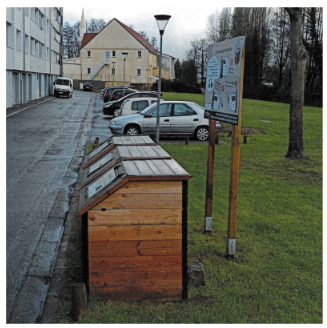
The tonnage of waste received increased, and the quality of sorting improved significantly.
Several residents stated that the door-to-door distribution of the organic waste bags had been a good catalyst, but some residents refused or stopped sorting out of fear of nuisance or because they had doubts about their neighbours’ behaviour.
The introduction of transparent bags was identified as a favourable moment for establishing new sorting habits.
Finally, whilst awareness-raising materials (stickers and ‘sorting discs’) were deemed useful, some confusion remains, particularly due to language barriers, which can often be overcome through a one-to-one conversation.
Points to bear in mind
Appoint a project manager to oversee and coordinate the project throughout its duration (door-to-door visits, organisation, engaging with residents, etc.).
Work with a local representative (in this case, the neighbourhood council) to facilitate the recruitment of residents for the trial and to better establish Sirtom as a trusted partner.
Sources
Extract: the experience of Flers, pages 12–13
To go further
At the Sirtom for the Flers-Condé region
-
Anne Moreau, Director-General of Services : dgs[@]sirtom-flers-conde.fr
-
Alain Ridaoui, Project Manager for Bio-waste and Waste Prevention : a.ridaoui[@]sirtom-flers-conde.fr