Supporting waste sorting in multi-occupancy housing: the Avranches experience
5 pilot schemes to promote the sorting of bio-waste at source
June 2026
Agence pour l’Environnement et la Maîtrise de l’Energie (ADEME)
In Avranches, a new voluntary waste sorting scheme has been introduced to enable households in block-of-flats to dispose of their bio-waste there. Ahead of its launch in March 2025, teams from the Bio-waste Collection and Composting Service of the Mont-Saint-Michel Normandie Urban Community wanted to anticipate potential obstacles and understand how to encourage residents to take up this new practice.
To download : 2026_06__guide_concertation_biodechets_fr.pdf (5 MiB)
Assessment
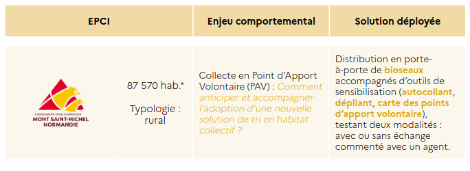
The team presented the organic waste sorting solutions currently being rolled out to local residents. Several residents questioned the usefulness of sorting and its impact, stating that they lacked clarity on what happens to the organic waste. Both elected representatives and residents also expressed concerns about the hygiene of the scheme, the risk of fly-tipping and the possible proliferation of pests (rats).
Solution developed
To address these concerns, a door-to-door awareness campaign was planned, with two trial methods:
-
a door-to-door handover with an explanation, carried out by a council officer, for one-third of the organic waste bins to be distributed;
-
a simple drop-off at the front door of homes for two-thirds of the organic waste bins to be distributed.
Both in terms of taking action and understanding the scheme, the highest level of uptake was found amongst those who received the guided distribution. The emphasis was placed on ease of action and engagement:
-
Direct handover of a ‘bioseau’ with no additional steps required.
-
Provision of support materials (stickers with sorting instructions, an explanatory leaflet, a map showing the nearest recycling point).
-
Highlighting the tangible impact of sorting in all materials and in the agent’s explanations.
-
Discussions with agents to strengthen support for the scheme.
Results
114 evaluation interviews were conducted three months after the distribution, involving 36 people who had been visited by a staff member, 54 who had used a drop-off point without receiving any guidance, and 24 encounters at a voluntary waste collection point.
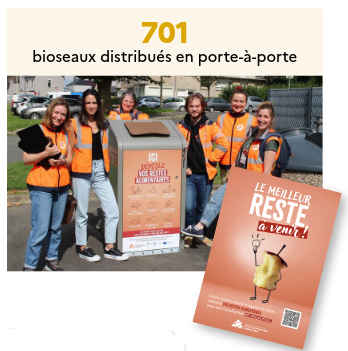
Both in terms of taking action and understanding the scheme, the highest level of uptake was found among those who had received a guided handover.
The communication materials were deemed useful, but their impact depended on the quality of the interaction established when they were handed out. Some elderly people or non-French speakers did indeed find it difficult to understand the instructions, even with visual aids.
Finally, some felt that the size of the bio-bag was insufficient.
In summary
The evaluation confirms the effectiveness of the door-to-door approach with explanations, whilst highlighting comprehension difficulties for certain groups.
The team plans to strengthen support for these groups, in particular by offering versions adapted to people’s language or age. Regular monitoring of the scheme’s impact on residents is also being considered.
| “ Without this support for change, we would not have been able to carry out the assessment using the questionnaires. […] The pilot scheme was cited as an example by local councillors in one municipality to encourage other councillors to use the questionnaire method. ” |
Points to bear in mind
Consider the timing : staff believe that installing the collection points in advance would have allowed residents to visualise the scheme more clearly.
Facilitate genuine and fluid interaction :
-
Interviews in neutral settings where waste management is not the central focus (sewing workshops, markets, etc.).
-
Use of digital interview forms (tablets) to speed up data entry and minimise transcription errors.
-
Advance notice posted in blocks of flats to inform residents of the distribution and increase their availability, as well as the quality of the reception provided by staff.
-
Standardise the messaging of staff responsible for the presentation using a conversation guide.
Sources
Extract: the Avanches experience, pages 10–11