Experiences of regions in transition : the Crêtes Préardennaises Community of Municipalities
mayo 2021
Territoires à Energie Positive (TEPOS)
The Crêtes Préardennaises, a rural area in the Ardennes (22 people per km²), has built its transition on two inseparable pillars: citizen engagement and collaborative innovation.
As early as 2002, the Pays des Crêtes launched a participatory initiative that gave rise to a dense network of organizations (ALE 08, Enéole, Enercoop Ardennes Champagne) and flagship projects such as the Ailes des Crêtes community-owned wind farm.
With a voluntary PCAET adopted in 2013, the region has nearly achieved its energy goals, with renewable electricity production at 160% of its needs.
Today, the Crêtes Préardennaises are focusing on agriculture (ClimAgri), sustainable mobility, and multi-stakeholder governance (elected officials, technical experts, residents, and partners) to continue on their TEPOS trajectory. This proves that the transition can emerge from the grassroots and draw on collective intelligence.
Para descargar: porter-un-projet-de-territoire-en-transition-2021_fr.pdf (4,3 MiB)
In this sparsely populated rural area (22 inhabitants per km²) located in the heart of the Ardennes, the energy transition and the mobilization of local stakeholders have been two constants in regional development policies since the early 2000s. A culture of citizen participation has gradually taken root. The region has become more attractive, with a 10% increase in population over the past decade.
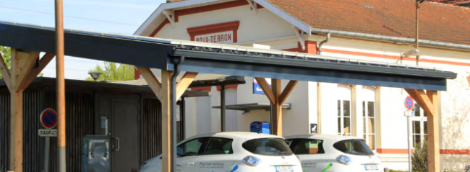
Balancing stakeholder engagement, the implementation of concrete projects, and the planning process
In 2002, the Pays des Crêtes préardennaises was established to involve residents and local stakeholders in the development of community projects and to affirm the region’s rural identity. A participatory action training program facilitated with support from the national association ADES created fertile ground for the emergence of individual and collective initiatives. This momentum gave rise to the development council and several associations, including the Ardennes Local Energy Agency (ALE 08). To this day, they remain key partners of the local government in its transition efforts. In 2003, the community of communes and the region sought to give greater prominence to energy issues. With the help of the local energy agency, they established a wind energy development plan for the region that would serve as a model for the national Wind Energy Development Zones (ZDE) program. Projects followed one after another: the creation of the local development company Enéole, dedicated to community-led renewable energy projects in Les Crêtes; a renovation program; the region’s application to the LEADER program, which was approved in 2007; and support for the 2009 founding of SCIC Enercoop Ardennes Champagne, the first local cooperative affiliated with Enercoop. In 2013, the region committed to a voluntary climate plan, involving local stakeholders in its development over several months. The TEPOS ambition is clearly stated in the plan, as the goal is to become 100% renewable energy by 2020 (excluding the transportation sector).
Over time, the momentum generated by the region around the climate plan was gradually taken up by the community of communes, which created a dedicated project manager position. In 2015, the community of communes became more actively involved in the national TEPOS network and was awarded TEPCV status. The local authority partnered with ALE 08, Enéole, and Enercoop Ardennes Champagne to develop the “Ailes des Crêtes” community-owned wind farm between 2011 and 2016, by acquiring equity shares and encouraging the municipalities to do the same. The new LEADER program, launched in 2014 under the slogan “ to be a territory with positive energy, to make the most of natural resources, and to invest in human development ,” has been a resounding success. Projects are pouring in, and all the funds have already been spent two years before the program’s end !
With the implementation of the Cit’ergie initiative and the mobilization of the local government’s various departments, sector-specific policies are gradually taking on a green focus (culture, tourism, and economic development). For example, businesses can receive subsidies for purchasing products related to sustainable development.
To ensure that the energy transition informs land-use and urban planning policies, the municipality plans to apply the Environmental Approach to Urban Planning (AEU) promoted by ADEME in the development of its intermunicipal local urban plan. While the transition is well established within its own territory, the Crêtes préardennaises region is finding it more difficult to get neighboring territories on board with the territorial coherence plan.
Today, a regulatory PCAET is in the process of being adopted. The assessment of the voluntary climate plan launched in 2013 showed that the energy and greenhouse gas emission reduction targets have almost been met. The renewable electricity production target has even been exceeded, with production now amounting to 160% of the region’s electricity consumption. Monitoring of energy and climate targets is carried out through the regional climate-energy observatory and Cit’ergie indicators.
Involving the region’s diverse stakeholders
Involving staff, elected officials, and residents in defining and implementing energy transition projects is a constant priority for the vice president in charge of energy and ecological transition and the coordinator of the energy transition initiative. To ensure that the community council’s decisions are as closely aligned as possible with local concerns, committees organized by geographic sector are convened prior to council meetings, with host municipalities rotating on a rotating basis. Municipal council members from the host municipality are systematically invited to the meeting. Thus, these committees provide an opportunity to discuss transition projects to be undertaken by the intermunicipal body, to understand the positions of elected officials, and to bring forward ideas for municipal projects. Municipalities that wish to do so also benefit from the shared energy advisory service offered by ALE 08 and co-funded by the community of municipalities. They can receive specific support for developing transition projects that are part of a municipal implementation of the climate plan.
Residents are directly involved in renewable energy projects. Farmers, who represent the region’s leading economic sector, are engaged on the issue of climate change through the implementation of the ClimAgri approach. This method aims to collectively define a strategy and action plan to adapt the region’s agricultural activities in order to reduce greenhouse gas emissions and anticipate the effects of climate change on their crops.
In 2019, elected officials, staff, and residents came together to develop the PCAET strategy using the Destination TEPOS method. The region’s targets for 2030 thus correspond to the average of the scenarios proposed by each stakeholder group: a 36% reduction in energy consumption and a 40% reduction in greenhouse gas emissions. The goal of energy self-sufficiency has been reaffirmed and even expanded, now including energy consumption from transportation. Efforts must now focus on meeting heating needs through renewable energy production and transforming mobility practices to reduce their energy and climate impacts.
In January 2020, the local government signed an energy transition contract. This initiative helped mobilize partners (particularly government agencies) around the region’s project while giving it greater visibility. Co-funding for a position focused on sustainable agriculture and food was secured from ADEME, in addition to funding for the position dedicated to the transition.
However, the actions outlined in the contract did not receive specific financial support, and the drafting and monitoring of the contract are considered time-consuming.
To facilitate the governance of transition projects and the monitoring of various initiatives, an energy transition steering committee was established in 2015. It brings together key drivers, elected officials, technical staff, residents, and local government partners (ADEME, ALE, etc.) and is expanding as support mechanisms are introduced. Monitoring of the ecological transition contract will be coordinated through this body. Over the course of a half-day, the group reviewed the implementation of the PCAET, as well as the progress of Cit’ergie and the CTE.
Maintaining Momentum Over the Years
The start of the new municipal term provides an opportunity to reaffirm commitment to the TEPOS project. With the arrival of new elected officials, it is necessary to take the time to rebuild a shared culture around the regional project. A program of outreach activities supported by Unadel to update the regional project, group training on climate, air, and energy issues, and a new communication campaign targeting residents are planned for 2021.
Highlights of the Experience
-
A dense and dynamic network of local organizations that emerged in the early 2000s under the leadership of the Pays
-
Systematic involvement of local stakeholders and residents in projects
-
Active participation in numerous networks and forums for exchange at the departmental, regional, and national levels
-
Collegial leadership that strengthens the resilience of the regional development plan
-
A multi-stakeholder transition steering committee (elected officials, partners, citizens, etc.) to facilitate
the monitoring of initiatives
Timeline of key milestones :
-
In 1996, the community of municipalities was created.
-
In 2000, the “Pays” initiative : a dedicated coordinator mobilized 200 local stakeholders, leading to the creation of the Ardennes Local Energy Agency (ALE 08).
-
In 2005, the OPAH thermal renovation program for buildings.
-
In 2007, the LEADER program “ Valorization of Local Resources ” (Europe) : a LEADER coordinator was hired.
-
In 2013, PCET (Region / ADEME / Europe, ERDF) : a climate action project manager and a shared energy advisor were hired.
-
In 2015, TEPCV (National Government) : the climate plan project manager worked on electric mobility, agriculture and market gardening, thermal renovation of public buildings, a micro-hydropower study, coordinating village power plants, and awareness-raising and communication.
-
In 2016, the LEADER program “Becoming an Energy-Positive Region” (Europe) and support for behavioral change (ADEME) : the climate action coordinator develops the “Ailes des Crêtes” community wind farm.
-
In 2017, Cap Cit’ergie certification (ADEME) : consultation with a Cit’ergie advisor. ClimAgri initiative.
-
In 2019, development of the PCAET.
-
In 2020, Ecological Transition Contract (ADEME, support for behavioral change): the climate action coordinator position is retained.
-
In 2021, support for behavioral change (ADEME): a sustainable agriculture and food project manager is hired.
Referencias
Tepos Document : Leading a Regional Transition Project (French version) ; excerpt from pages 44–47
Para ir más allá
(French version)