Experiences from Regions in Transition: The City of Malaunay
mayo 2021
Territoires à Energie Positive (TEPOS)
Malaunay (population 6,000, near Rouen) is a testing ground for transition at the municipal level.
As early as 2006, an internal eco-citizen committee (comprising staff and elected officials) launched concrete initiatives, followed by a Cit’ergie initiative (certification obtained in 2015) and a €10 million TEPCV program to renovate public buildings and develop renewable energy.
The city has reduced its energy bill by 270,000 € per year thanks to a strategy focused on conservation and efficiency. What makes it unique? Strong citizen engagement: the “La transition prend ses quartiers” challenge, an educational comic book, and SLIME (a local energy management intervention service) for low-income households.
Malaunay has also spread its momentum throughout the Rouen metropolitan area, with 1,138 commitments made by 70 municipalities as part of “Notre COP 21.” This proves that even a small town can become a major player in the energy transition.
Para descargar: porter-un-projet-de-territoire-en-transition-2021_fr.pdf (4,3 MiB)
Malaunay, a small town of 6,000 residents located near Rouen, aims to achieve energy self-sufficiency by 2050, seeking to turn its challenges into opportunities. About ten years ago, ideas from an internal eco-citizen committee spurred the community toward the energy transition, and concrete projects began to take shape. The initiative has evolved into a comprehensive regional project focused on the energy transition and regional development, working closely with residents. Now recognized at the regional and national levels, the town is a major player in the energy transition of the Rouen metropolitan area.
From the Eco-Citizen Committee to Exemplary Leadership Recognized with the Cit’ergie Label
It all began in 2006. On a voluntary basis, an eco-citizen committee was established for Malaunay’s staff and elected officials. The mayor at the time was almost always present. Starting with concrete issues, the committee developed proposals to reduce the community’s environmental impact and energy consumption. An internal culture gradually took shape around energy and climate issues, and 50 initiatives were implemented over the course of three years.
In 2010, ADEME Haute-Normandie issued a call for expressions of interest to local governments to join the Cit’ergie initiative. Malaunay joined the process, which is typically undertaken by medium- and large-sized municipalities. Guillaume Coutey, who became mayor of the town in 2012, has since championed this pioneering initiative alongside the municipal team and the administrative departments led by Laurent Fussien, Director General of Services—both of whom are convinced of the initiative’s merits. Transition workshops organized that same year with elected officials, municipal staff, and third-party civil society actors helped forge a consensus: the energy transition is a central issue for the region, offering multiple benefits beyond the fight against climate change (economic, societal, social, and environmental). The municipality’s roadmap is extensive: 176 operational actions to be implemented! The signing of an agreement with ADEME to support behavioral change then made it possible to convert a job placement contract into a position as energy and climate project manager. Her technical expertise proved indispensable in monitoring the numerous energy-renovation projects and subsequently in supporting residents and schools.
In 2011, the municipality strengthened its team focused on transition issues by hiring a project manager dedicated to overseeing Cit’ergie, then TEPCV, and who now heads the Department of Environment and Technical Resources. Two years later, the municipality’s efforts were rewarded with the Cap Cit’ergie certification, having achieved 40% of its targets. In 2015, it earned the Cit’ergie certification, demonstrating that the municipality continues to make progress.
A Major Investment Program Launched Under the Impetus of TEPCV
When the TEPCV call for projects was announced in 2014, the municipality did not hesitate for a single second to respond.
There was no shortage of project ideas. This was an opportunity to develop an investment program worth over 10 million euros to renovate public infrastructure, install a community-owned solar power plant for self-consumption, and replace the aging fleet of municipal vehicles with electric and biomethane models. In addition to the ministry’s assistance, the municipality secured the funding for this major program through proceeds from the sale of underutilized assets, a loan, and self-financing. The sale of buildings ill-suited to the municipality’s needs has been part of its strategy since 2012, with the goal of improving the energy efficiency of its most-used buildings and promoting energy conservation. For example, rather than maintaining a nursery that was too small and a daycare center that was too large—and bearing the costs associated with both facilities—the municipality financed the high-performance energy renovation and expansion of the nursery using the proceeds from the sale of the daycare center.
The renovation of its municipal buildings enabled the municipality to save more than €70,000 on its annual energy bill between 2006 and 2018, even as gas and electricity prices rose significantly during that same period. In 2018, the municipality saved nearly 270,000 € compared to a “do-nothing” scenario—that is, compared to the bill it would have paid had it taken no action.
Citizens Involved in the Transition Effort
Gradually, the municipality is turning to local stakeholders, establishing a local energy efficiency intervention service (SLIME) for low-income households and building a network of local entrepreneurs. It is investing in the development of Enercoop Normandie by joining its board of directors, training its staff in the négaWatt approach, and raising awareness among students about the ecological transition. Finally, it has committed to investing 10% in any citizen-led renewable energy project, while playing a key role in fostering a participatory renewable energy development project in the region.
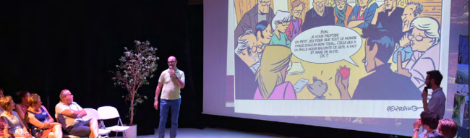
The momentum generated by its participation in discussions within the TEPOS network and its meeting with the team from Loos-en-Gohelle spurred Malaunay to expand the local scope of its initiative and seek the involvement of its residents. In 2018, the municipality launched the challenge “ The Transition Takes Root .” The idea? To form seven teams of residents and assign them challenges to tackle in the areas of energy, waste, mobility, food, responsible consumption, biodiversity, and well-being. The experiences of these families were captured in illustrations and a narrative in a comic book to inspire as many people as possible to take the leap toward the transition. The benefits are numerous, both for the residents who participated and for the staff who coached them. Today, citizen participation in community projects is essential, and residents have developed the habit of turning to City Hall to carry out their initiatives. The residents’ wishes gathered during the last community festival further enrich the action plan with new ideas.
It is on the social front that the municipality is now seeking to redouble its efforts to ensure that the entire population—even the most vulnerable—is part of this transition process.
Scaling Up
Now recognized at the regional and national levels, Malaunay can take pride in having played a leading role within the metropolitan area. With a specialist in local energy transition policies—recruited by the metropolitan authority and since promoted to vice president—Guillaume Coutey spent nine months traveling throughout the region to meet with the mayors of the 71 municipalities and their teams. Their goal? To encourage the municipalities to adopt a list of commitments as part of the metropolitan project “Notre COP 21.” The initiative was a success, with 1,138 commitments made by 70 municipalities. With the momentum now building at the metropolitan level, Malaunay expects the transition to scale up and multiply its ripple effect!
The drive to spread this model doesn’t stop there. Laurent Fussien and Guillaume Coutey are actively participating in the work of the Fabrique des transitions, in the hope that Malaunay and other pioneering transition communities will not remain isolated cases. To draw lessons that can benefit others, the municipality has not hesitated to involve researchers and would like to continue this “laboratory” approach with the help of ADEME.
Highlights of the Experience
-
The bold decisions made by elected officials, such as adapting the municipality’s assets to new uses by selling some buildings to fund the renovation of others.
-
A highly committed technical team and an internal organization that evolves alongside the municipality’s ambitions.
-
Resident engagement and communication about initiatives to build local momentum and forge partnerships to bring projects to fruition.
-
Ambition without losing sight of reality: large-scale, transformative projects facilitate the mobilization of financial aid.
Timeline of Key Milestones :
-
In 2006, creation of the Eco-Citizens Committee for municipal staff and elected officials.
-
In 2010, Cit’ergie initiative (ADEME) : consultation with a Cit’ergie advisor to conduct a preliminary assessment prior to defining the vision and an action plan.
-
In 2012, energy-efficient renovation of the gymnasium (ADEME, PREBAT). Revision of the Local Urban Planning Plan (PLU) to account for the energy transition (ADEME, AEU grant) : a proactive environmental approach to urban planning, “BIMBY” pilot project. Energy Management System (ADEME, external engineering grant): project management assistance + 1 internal staff member to create management and reporting tools and evaluate the performance of public initiatives (air quality, health, energy, etc.).
-
In 2013, Cap Cit’ergie certification.
-
In 2014, TEPCV (Government) : renovation of public infrastructure, renewal of the municipal vehicle fleet, and photovoltaic systems for self-consumption. In 2015, Cit’ergie certification (55% of targets achieved).
-
In 2016, support for behavioral change (ADEME, 3 years) : an energy and climate project manager launched work on the TEPCV action plan.
-
In 2018, resident engagement : “ the transition takes root .” COP 21 for the Rouen metropolitan area : support from a specialist in local energy transition policies to mobilize municipalities (1,138 commitments made by 70 municipalities).
-
In 2019, support for behavioral change (ADEME, 3 years): 1 FTE divided between two positions: energy management system project manager and citizen engagement in the transition project manager. Collective self-consumption for the 10 solar rooftops installed on public buildings. Peer city workshop with Le Mené, Grande-Synthe, and Loos-en-Gohelle.
-
In 2020, PCAET incorporating social and biodiversity issues.
-
In 2021, Cit’ergie certification maintained (71.5% of targets achieved).
Referencias
Tepos Document : Leading a Regional Transition Project (French version) ; excerpt from pages 54–58