How cities can harness the power of communities to drive ambitious clean air action
Local Voices, Cleaner Air
Luisa Miranda Morel, Chloe Watson, 2026
What if the key to cleaning up the air in our cities lay in listening to those who live there ? In a world where 9 out of 10 people breathe polluted air (WHO), local authorities need to rethink their approach : air quality cannot be imposed; it must be developed in partnership with citizens.
This report, produced as part of the Breathe Cities initiative (led by Bloomberg Philanthropies, the Clean Air Fund and C40 Cities), reveals how community engagement transforms technical policies into concrete, equitable and sustainable actions.
Through inspiring case studies (Rio, Jakarta, London, etc.) and proven methods, it offers a roadmap for making residents key players in the transition towards healthier air.
To download : local_voices_cleaner_air_-_2.pdf (2.3 MiB)
Clean air: everyone’s business
1. Why is community involvement essential ?
Air pollution is not an abstract concept : it affects people differently, depending on where they live, their occupation or their access to healthcare. Traditional policies, often devised without the input of those directly affected, fail to capture this complex reality. Yet when cities listen to, involve and work alongside their residents, the results are more relevant, better accepted and more effective (p. 6).
The benefits of an inclusive approach
Community engagement makes it possible to :
-
Make the invisible visible : Link technical data (e.g. PM2.5 levels) to lived realities (e.g. the daily commutes of healthcare workers in Bogotá, p. 26). Low-cost sensors, for example, reveal pollution hotspots overlooked by official networks (p. 12).
-
Build trust : In contexts where institutions are perceived as remote (e.g. Roma communities in Sofia, p. 30), a transparent and respectful approach restores dialogue and prevents policies from being rejected.
-
Unlocking innovation: The most effective solutions often emerge from the grassroots. In Bangkok, residents have co-designed anti-pollution communal spaces (p. 27), whilst in Johannesburg, young people have launched awareness campaigns tailored to their generation (p. 31).
-
Ensuring sustainability : When communities take ownership of initiatives (e.g. : citizen monitoring in London, p. 34), policies endure beyond changes in leadership and become embedded in everyday life.

2. Five forms of engagement to improve air quality
The report identifies five complementary approaches, to be adapted according to the context and stage of the project (pp. 15–33). Each method addresses specific needs, but it is their combination that maximises impact.
Sharing information : making the issue concrete
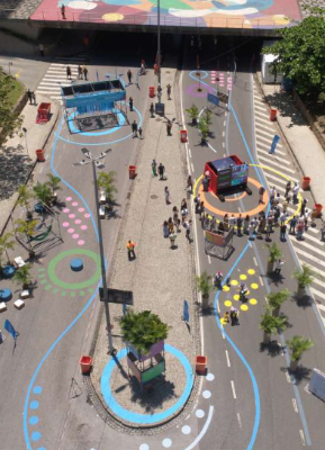
Clean air is an abstract issue for many. To make it tangible, cities must translate the data into clear messages rooted in everyday life. In Rio de Janeiro, an immersive street festival helped to visualise the benefits of a low-emission zone (LEZ) by temporarily transforming a financial hub into a pedestrianised, cultural and green space (p. 19). The result : 2,000 participants and extensive media coverage, laying the foundations for the policy’s future adoption.
Key methods : Awareness campaigns, open data (e.g. : Breathe London), digital tools (p. 20).
Gathering feedback : listening to take better action
The most successful policies stem from active listening.
Jakarta used a needs assessment to design its low-emission zone (KRE-T), consulting delivery drivers, street vendors and residents of priority neighbourhoods (Blok M, Dukuh Atas). This approach revealed unforeseen obstacles (e.g. economic dependence on the street) and enabled exemptions and support measures to be tailored accordingly (p. 22). In Mexico City, interviews with taxi drivers highlighted the financial and operational barriers to adopting electric vehicles (initial cost, access to credit, charging infrastructure), leading to a review of the subsidy programme (p. 23).
Key methods : Surveys, workshops, digital consultations (p. 24).
Co-creating solutions : involving communities from the design phase onwards
Involving communities from the design phase onwards prevents solutions that are out of touch with reality. In Bogotá, focus groups with family carers (mostly women) revealed that their frequent journeys on foot (to schools, health centres) exposed them to higher levels of pollution. Using wearable sensors, the city identified high-risk routes and planned targeted improvements (p. 26). In Bangkok, residents from 15 districts were trained to propose local projects (e.g. : air-filtered community halls), supported by public grants (p. 27).
Key methods : Co-design workshops, iterative testing (p. 28).
Partnering to deliver action : sharing responsibilities
Collaboration between institutions and communities enhances effectiveness. In Sofia, a partnership with Roma communities helped to understand their heating practices and to co-develop affordable and tailored solutions (insulation, optimisation of air conditioning systems), going beyond simply switching fuels (p. 30). In Johannesburg, young ‘air champions’ were trained to run campaigns (on waste, industrial emissions) and submit a formal advocacy proposal to the city council, incorporating their priorities (health, green jobs) into local policies (p. 31).
Key methods : Joint working groups, advisory committees (p. 32).
Enabling community-led change : empowering citizens
Empowering residents multiplies the impact. London combined formal consultations with financial support (£7.7 million) to enable local groups to measure pollution (using low-cost sensors) and take action (e.g. : closing roads near schools, reducing NO₂ by 23 per cent, p. 34).
Key methods : Citizen science, participatory budgeting (p. 35).
3. Putting engagement into practice : keys to success
To ensure that engagement is not merely symbolic, cities must adhere to seven principles (pp. 37–45) :
-
Clarify the influence of communities
Residents must know what they can change (e.g. : the design of a pedestrian zone) and what is non-negotiable (e.g. : national standards). In London, transparency regarding regulatory constraints prevented frustration during the expansion of the ULEZ (Ultra Low Emission Zone) (p. 38).
-
Linking air quality to everyday concerns
Pollution must be linked to concrete issues: health (asthma, cancers), the economy (transport costs), or quality of life (noise, green spaces). In Rio, the Respira Rio festival demonstrated how a low-emission zone would improve the quality of life (less noise, more green spaces, p. 19).
-
Building trust: a long and delicate process
Mistrust of institutions does not disappear overnight. It is often the result of disappointing past experiences, where promises were not kept or where the voices of communities were ignored. To rebuild it, one must act with patience and consistency.
In Sofia, for example, Roma communities – often marginalised and stigmatised – have long viewed public policies with scepticism. By working with trusted intermediaries, such as the NGO Trust for Social Achievement, the city was able to establish a genuine dialogue. The air-quality sensors installed in homes did not merely provide data : they also demonstrated that residents’ concerns were being taken seriously. Gradually, discussions evolved from mistrust to constructive collaboration on tailored solutions, such as improving home insulation or optimising heating systems (p. 30).
Building trust also means recognising local knowledge. Residents know their neighbourhood better than anyone else: their feedback on overlooked sources of pollution or practical obstacles (cost, accessibility) is an invaluable resource. In Jakarta, by involving delivery drivers and street vendors in the design of the low-emission zone, the city avoided unnecessary resistance and was able to adapt its measures to the realities on the ground (p. 22).
-
Aligning engagement with decision-making cycles
Participatory processes must be part of the long-term framework of public policy, where every step counts. In Jakarta, for example, engagement was carefully phased to coincide with key stages in the regulation of the low-emission zone (KRE-T). By synchronising consultations with the design, testing and finalisation stages, the city was able to incorporate residents’ feedback at the right time, thereby avoiding costly adjustments or resistance later on (p. 22).
This approach requires rigorous planning. Cities must anticipate administrative delays, statutory consultation periods and implementation phases. In London, the ULEZ was rolled out in stages, with consultation points at each major phase. This allowed citizens to adapt gradually and enabled the authorities to make course corrections based on feedback, such as adjusting exemptions for essential vehicles (p. 34).
-
Optimising resources
Community engagement can draw on existing resources to maximise its impact. In Johannesburg, the AirAware campaign mobilised young people who were already organised into school or university groups, thereby reducing mobilisation costs (p. 31).
It is also possible to target investments to include vulnerable populations, as in Bogotá, where workshops with family carers were organised at suitable times (p. 26).
-
Coordinate institutional stakeholders
Air quality is a cross-cutting issue that affects transport, health, urban planning, energy and the environment. However, these sectors often operate in silos, with conflicting objectives or mismatched timetables. Internal coordination is therefore essential.
In London, the introduction of the ULEZ1 required close collaboration between the transport, public health and environment departments. By setting up cross-departmental working groups, the city was able to align its priorities and ensure consistent communication (p. 43).
This coordination also relies on formal mechanisms, such as inter-departmental committees dedicated to air quality, where each department contributes its expertise.
-
Sustaining commitment over time
Community engagement must not be a flash in the pan. In London, following the launch of the ULEZ, the local authority continued its dialogue with communities through monitoring groups and ongoing feedback platforms. Residents can thus report issues and track progress via accessible dashboards (p. 34).
To prevent engagement from fizzling out, cities can establish key milestones in the calendar. In Bogotá, quarterly meetings were organised to review project progress and celebrate small victories (p. 26).
4. Case studies : cities that inspire
Concrete examples from Rio de Janeiro, Jakarta, Mexico City, Bogotá, Bangkok, Sofia, Johannesburg and London illustrate how community engagement can transform policies into lasting successes.
-
Rio de Janeiro has opted for a festive and immersive approach to showcase its future low-emission zone. By transforming a street in the city centre into a pedestrianised, cultural and green space for the duration of a festival, the local authority made a project that might otherwise have seemed abstract both tangible and appealing. The result : massive public engagement and media coverage that laid the foundations for the policy’s future adoption (p. 19).
-
In Jakarta, the city realised that to design an effective low-emission zone, it needed to listen to those who experience its impacts on a daily basis. By organising consultations with delivery drivers, street vendors and residents of the affected neighbourhoods, it was able to tailor the restrictions and support measures to ensure they were fair and realistic (p. 22).
-
Mexico City, for its part, targeted a specific group: taxi drivers. By gathering their feedback on the barriers to electrification, the city was able to adjust its subsidy programme to make it more accessible (p. 23).
-
In Bogotá, it was family carers – predominantly women – who were placed at the heart of the discussions. Their daily journeys on foot revealed previously unseen exposure to pollution, leading to targeted improvements (p. 26).
-
Bangkok has trained residents from 15 districts to propose local solutions themselves, such as filtered communal spaces, supported by public grants (p. 27).
-
In Sofia, collaboration with Roma communities has enabled the co-development of tailored and affordable solutions to improve indoor air quality, combining technical data with local knowledge (p. 30).
-
Johannesburg has relied on young people to drive its action forward. Through the AirAware campaign, more than 1,100 young people were trained, and eight of them became air quality champions, submitting a formal petition to the city council (p. 31).
-
Finally, London has demonstrated how to combine various forms of engagement to maximise impact, achieving a 23 per cent reduction in NO₂ levels near schools through citizen science (p. 34).
5. Key lessons and recommendations
The report draws seven key lessons for cities (p. 46) :
-
Action for clean air is more effective when it comes from communities: policies rooted in local realities (e.g. : carers’ journeys in Bogotá) are fairer and more effective.
-
There is no one-size-fits-all model : cities can combine different approaches (information, consultation, co-design, etc.) according to their needs.
-
Quality takes precedence over quantity : a small, highly engaged group can have a greater impact than a broad but superficial consultation.
-
Engagement is a collective endeavour : an ecosystem (communities, NGOs, researchers, businesses) must be mobilised to ensure sustainable action.
-
Creating an ecosystem of stakeholders : combining local knowledge and technical expertise to develop innovative and tailored solutions.
-
Measuring impact : assessing who has been affected, what changes have been brought about, and how to improve future processes (p. 45).
-
Meaningful engagement = sustainable change : when communities feel listened to and empowered, policies stand the test of time.
6. Conclusion : Towards breathable cities
This report proves that air quality cannot be dictated from an office : it is co-created with those who experience it on a daily basis. The examples of Rio, Jakarta, London and Bogotá show that cities which dare to listen to, involve and empower their residents achieve more ambitious, fairer and more sustainable results.
To achieve this, we must :
-
Move away from top-down approaches and trust in collective intelligence.
-
Make the invisible visible by linking data and lived experiences.
-
Build bridges between institutions and communities, especially the most marginalised.
-
Make a long-term commitment, as trust and impact are built step by step.
What if your city became the next success story ?
This summary is based on the report “ Local Voices, Cleaner Air: How cities can harness the power of communities to drive ambitious clean air action ” (Breathe Cities, 2026). To find out more, see the pages listed or explore the detailed case studies (pp. 19–35)
1 : ULEZ (Ultra Low Emission Zone) is a scheme introduced in London to reduce air pollution by restricting access for the most polluting vehicles within a defined area of the city centre and its outskirts.
Sources
To go further
-
Breathe Cities : breathecities.org/
-
C40 Cities : www.c40.org/