Partizánske: how a Slovak town is reinventing bio-waste management
Branislav Moňok, Lenka Beznáková, October 2024
In Slovakia, where the management of bio-waste remains a major challenge for many local authorities, Partizánske has set itself apart with an innovative, tailor-made approach.
With a population of 20,000 and strong political commitment, this town has introduced a dual system: home composting for detached houses and door-to-door collection of bio-waste for blocks of flats. The results are impressive: 95 per cent of households in detached homes compost, reducing their residual waste by 118 kg per inhabitant, whilst the collection of bio-waste from blocks of flats has a very low contamination rate (proportion of non-organic waste) of just 0.07 per cent.
But what makes Partizánske unique is that it has successfully combined environmental performance with economic viability, proving that zero waste can be both environmentally sound and profitable.
To download : the-story-of-partizanske_en_.pdf (6.7 MiB)
A rather bleak picture in Slovakia
In Slovakia, waste management is characterised by structural challenges: full landfill sites, a lack of sorting infrastructure, and low public awareness. In a country where the average rate of separate collection struggles to exceed 41 per cent, bio-waste — which accounts for 30 to 40 per cent of the contents of residual waste bins — all too often ends up being incinerated or landfilled, releasing methane, a gas 28 times more potent than CO₂.
It is against this backdrop that Partizánske, a town of 20,000 inhabitants in the Trenčín region, decided to take matters into its own hands. With an average waste production of 408 kg per inhabitant per year (slightly below the national average of 478 kg), the council realised that the key lay ina differentiated approach : home composting for detached houses, and door-to-door collection for blocks of flats.
A dual system : two approaches towards a single goal
Partizánske has innovated by adapting its strategy to local circumstances. For detached houses (which account for 81 per cent of the housing stock), the town has focused on home composting, a low-cost and effective solution for reducing waste at source. As early as 2014, a pilot project in the Návojovce neighbourhood demonstrated the potential of this approach :
-
53 per cent of residual waste was bio-waste before the project.
-
After one year, this figure had fallen to 28 per cent, and the amount of residual waste per capita had decreased by 57 kg.
Building on this success, the city rolled out composting on a wider scale :
-
2,010 compost bins (with capacities of 290, 700 or 800 litres) were distributed free of charge to interested households.
-
41 free workshops were organised, attended by 2,110 participants.
-
800 home visits were carried out to check that best practice was being followed and to correct any mistakes.
Result : 95 per cent of households in detached houses now compost, reducing their residual waste by 118 kg per capita (36 per cent less than in 2016).
For block of flats, where home composting is difficult to implement, Partizánske has opted for a system of door-to-door collection of bio-waste, a first in Slovakia. Each household has received a starter kit: a 10-litre bin and 25 compostable bags. Collection takes place twice a week, with individual tracking via QR codes on each bin.
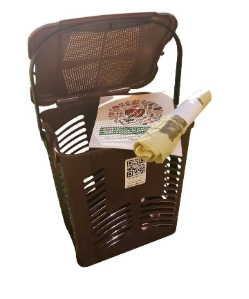
Starter kit for households : a 10-litre bin, 25 compostable bags and a leaflet for the general public
Depending on the type of building where collection takes place (with or without a lift), households must place the bin containing the sealed bag of food waste outside by 7 am on the scheduled collection day. In blocks of flats with a lift, it can be placed just outside the front door of each flat.
However, in blocks of flats without a lift, it must be placed on the ground floor, near the main entrance.
Results that exceed expectations
The figures from Partizánske are encouraging :
-
450.56 tonnes of bio-waste collected in 2023 (equivalent to 49.17 kg per participating resident).
-
The contamination rate (the proportion of non-organic waste, e.g. plastic packaging, cans, paper, etc., mistakenly mixed in with the collected bio-waste) is just 0.07 per cent (compared with 5 to 10 per cent in most European cities).
-
Overall reduction in residual waste: -18 per cent over 8 years for the whole town.
But what is most impressive is the economic aspect. Thanks to this system, Partizánske has reduced its costs :
-
Savings on landfill costs : less residual waste means lower landfill charges (which depend on the sorting rate in Slovakia).
-
Reduction in the frequency of residual waste collection : a reduction from 3 to 2 collections per week in apartment blocks, representing savings of €79,500 per year.
-
Government grants : the Slovak Environmental Fund provides financial support to local authorities that sort their bio-waste. In 2023, Partizánske received €35,431 for 450 tonnes of bio-waste collected.
Overall, the economic outcome is positive : in 2023, savings and revenue (€148,363) exceeded the costs (€103,921), generating a net profit of €9,000 for the municipality.
The keys to success: education, adaptation and collaboration
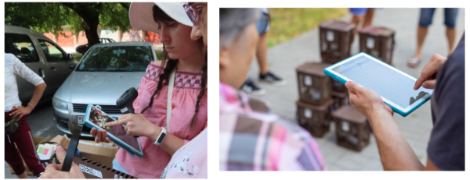
Partizánske’s success rests on three pillars:
-
Widespread and ongoing education. The town invested in raising awareness even before launching the new measures. Door-to-door surveys, public meetings, posters, articles in the local press and television reports helped to explain the issues at stake and best practices. For example, residents learnt :
Why compost : to reduce waste, produce natural fertiliser and save money.
How to sort waste properly : to avoid contamination (plastic, metal) in organic waste.
How to use compostable bags : to store them in a dry place and empty them regularly to prevent odours.
-
Solutions tailored to each type of housing. Partizánske has recognised that one size does not fit all :
For detached houses, home composting is the simplest and most cost-effective solution.
For blocks of flats, door-to-door collection using compostable bins and bags prevents hygiene issues (odours, insects) and ensures a minimal contamination rate.
-
Close collaboration with experts. The town has worked hand in hand with Priatelia Zeme – SPZ (Friends of the Earth Slovakia), a member of Zero Waste Europe, to design the system (choice of bins, collection frequency, QR code tracking), train council staff and community assistants, and to evaluate the results and adjust the system based on feedback from the field.
Taking it further : towards even more sustainable waste management
Partizánske has no intention of resting on its laurels. The town has already mapped out its zero-waste future, with projects aimed at consolidating its achievements and pushing the boundaries of what is possible in terms of bio-waste management.
One of the most promising avenues is the introduction of a reward scheme for the most committed households. The idea ? To offer financial incentives to residents who sort their waste most effectively, for example by offering them a reduction in waste collection charges or local benefits (free access to workshops, composted products, etc.). This type of measure, which has already been successfully trialled in other European cities such as Ljubljana and Ghent, could boost participation among the 35 per cent of households in blocks of flats that do not yet sort their bio-waste. In Slovakia, where financial incentives are still underdeveloped, such an initiative would be groundbreaking and could inspire other local authorities.
Another flagship project: the opening of a municipal composting plant by the end of 2024. Currently, the bio-waste collected is transported to a biogas plant, which incurs transport costs and limits local control over the treatment process. With its own plant, Partizánske could process its bio-waste locally, produce high-quality compost for local farmers, and even sell any surplus to generate additional revenue. This project is part ofa circular economy approach, where waste becomes a resource for the community.
Finally, the town is planning to extend its system to other waste streams, such as textiles or electronic waste. In Slovakia, where Extended Producer Responsibility (EPR) is beginning to be implemented, these waste streams represent untapped potential for further reducing residual waste. Partizánske could thus become a testing ground for innovative solutions in reuse and recycling, whilst strengthening its autonomy from private sector players.
An inspiring model for Europe : when local innovation sets the standard
Partizánske’s story is much more than just a local success story : it proves that even in an unfavourable context, a local authority can turn its challenges into opportunities and become a role model for an entire region, or even a continent. In Slovakia, where waste management is often lacking in ambition and where bio-waste still too often ends up in landfill, Partizánske has managed to innovate where others hesitated.
What makes its model unique is its dual approach: home composting for detached houses and door-to-door collection for blocks of flats. This adaptation to local realities shows that zero waste is not a one-size-fits-all solution, but a set of tailor-made measures designed to meet the specific needs of each area. In Europe, where many towns are still struggling to strike the right balance between efficiency, cost and public acceptance, Partizánske offers a clear roadmap: involving residents from the outset, providing widespread education, and choosing simple yet effective solutions.
But what is most impressive is that Partizánske has managed to combine environmental performance and economic viability. At a time when local authorities are often held back by costs, the town has demonstrated that zero waste can generate savings (reduced landfill charges, optimised collections) and even yield profits (grants, sale of compost). This virtuous economic model is a compelling argument for convincing other towns to follow suit.
Beyond Slovakia’s borders, Partizánske is already serving as an inspiration. Its door-to-door bio-waste collection system, with its record-low contamination rate of 0.07 per cent, is cited as a best practice within the European networks of Zero Waste Europe. Cities such as Ljubljana (Slovenia) and Ghent (Belgium) have adopted similar measures, proving that this model can be replicated. In Eastern Europe, where waste management infrastructure is often limited, Partizánske demonstrates that change is possible without massive investment, but with determination, ingenuity and strong citizen involvement.
Finally, Partizánske embodies a broader vision of zero waste: that of an ecological transition that benefits everyone. By reducing its waste, the town improves its residents’ quality of life (less pollution, fewer odours), creates local jobs (in collection, composting and education), and strengthens its resilience in the face of climate challenges. Its story proves that zero waste is not a utopian ideal reserved for large cities, but a reality accessible to all towns, whether large or small, rich or modest.
Sources
Document : The story of Partizanske
To go further
Zero Waste Europe : www.zerowasteeurope.eu
Mission Zero Academy : www.missionzeroacademy.eu/