Bio-factories in Greater Santiago (Chile)
Circular and resilient water management in urban areas
agosto 2025
ICLEI-Local Governments for Sustainability
In Santiago, bio-plants are transforming wastewater into valuable resources: clean water, energy and agricultural by-products.
This innovative project, led by the Municipal Sanitation Works Company (EMOS), illustrates how a megacity can close the water cycle by making the most of every drop, whilst reducing its environmental footprint and creating new economic opportunities.
Driven by a circular vision, this project demonstrates how waste can become a resource for a more sustainable and resilient city.
This factsheet summarises one of the 12 case studies in the document: Circular and Resilient Urban Water Management
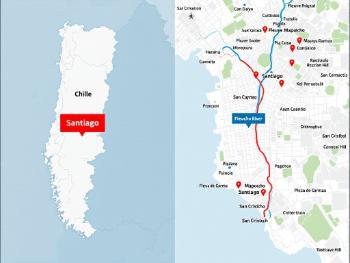
Greater Santiago, the capital of Chile, has a population of over 6 million and faces major challenges in terms of water management: water stress, wastewater pollution and pressure on natural resources. With a Mediterranean climate (dry summers, rainy winters), the city must find sustainable solutions to secure its water supply and reduce its environmental footprint. With rapid economic growth and dense urbanisation, Santiago also faces problems relating to pollution and waste management, requiring innovative approaches to a circular economy.
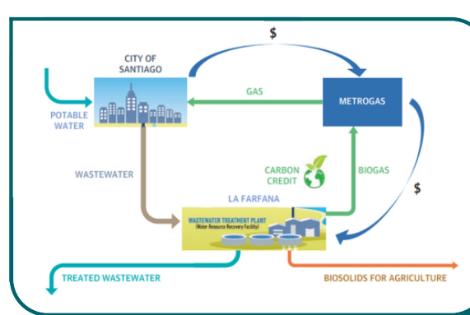
The Greater Santiago bio-plants, managed by the Municipal Sanitation Works Company (EMOS), transform wastewater into valuable resources: clean water, energy and agricultural by-products. This innovative project demonstrates how a megacity can close the water cycle by making the most of every drop, whilst reducing its carbon footprint and creating new economic opportunities. The aim is to treat 100 per cent of the city’s wastewater by 2030, whilst producing renewable energy and supplying recycled water for non-potable uses.
Solutions implemented
-
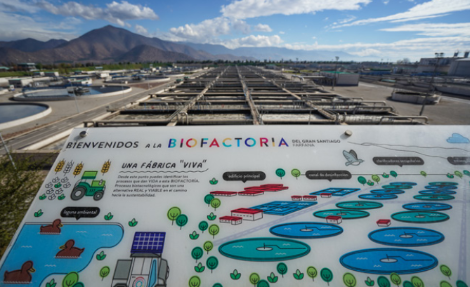
Bio-plants : Advanced treatment plants that combine biological processes (anaerobic digestion, sludge treatment) to produce recycled water, biogas and organic fertilisers.
-
Biogas production : The methane captured during the anaerobic digestion of sludge is used to generate electricity, thereby reducing dependence on fossil fuels.
-
Reuse of recycled water : The treated water is used for irrigating green spaces, industrial processes and other non-potable uses, thereby reducing pressure on freshwater resources.
-
By-product recovery : Treated sludge is converted into organic fertiliser for agriculture, thereby creating a circular economy.
Key results
-
Production of 100,000 m³/day of recycled water, reducing pressure on freshwater resources and supporting the city’s non-potable water needs.
-
Generation of 20 MW of electricity from biogas, powering the bio-plants and thereby reducing dependence on the national electricity grid.
-
A 30 per cent reduction in CO₂ emissions associated with wastewater treatment, thanks to the use of biogas and process optimisation.
-
Creation of local jobs in the water, energy and agriculture sectors, thereby contributing to the region’s economic development.
Climate and environmental impacts
-
Climate change mitigation :
- The production of biogas from wastewater reduces dependence on fossil fuels, thereby lowering CO₂ emissions.
- The reuse of recycled water reduces the need to pump and treat fresh water, an energy-intensive process.
- Bio-plants operate with reduced energy consumption, thanks to the use of biological processes and biogas.
-
Climate adaptation and resilience :
- Water security : The production of reclaimed water improves the availability of water for non-potable uses, thereby reducing the city’s vulnerability to water shortages.
- Wastewater management : Centralised and efficient wastewater treatment reduces the risk of pollution to watercourses and groundwater.
-
Biodiversity and water quality : Reducing discharges of untreated wastewater improves the quality of aquatic ecosystems, thereby protecting biodiversity and public health.
Success factors
-
Values :
- Recognition of the multiple value of wastewater (water, energy, nutrients).
- Integration of sustainability and the circular economy into resource management.
-
Connections :
- Physical connections : The bio-plants are integrated into the urban network, creating a coherent system for water and energy management.
- Social connections : Collaboration between EMOS, local authorities, businesses and residents to design solutions tailored to the city’s needs.
Investments :
-
Public funding : The project has received significant government support as part of national policies on sustainable water management.
-
Public-private partnerships : Collaboration with local businesses to optimise resource management and recovery.
Replicability in Morocco
The Santiago bio-plant model could inspire Moroccan cities such as Casablanca or Rabat, where wastewater recovery could reduce pressure on water resources and create economic opportunities. By combining centralised treatment, energy production and agricultural reuse, this project demonstrates how wastewater can become a strategic resource for urban development.
For example, in Casablanca, where wastewater is often discharged untreated, adopting this model would enable the production of recycled water for the irrigation of green spaces or industrial processes, whilst generating renewable energy and reducing pollution.
Referencias
Online document, see pages 135 to 146 : Gestion circulaire et résiliente de l’eau en milieu urbain - Circular and resilient water management in urban areas
Para ir más allá
Websites : iclei.org/ & iclei-europe.org/
Bibliography
1. Aguas Andinas. (2024). Reporte integrado [Rapport intégré] 2024. www.aguasandinasinversionistas.cl/~/media/Files/A/Aguas-IR-v2/reporte-integrado-2024-aguas- andinas-v42-alta.pdf
2. Aguas Andinas. (s.d.). Our history [Notre histoire]. www.aguasandinasinversionistas.cl/en/about-us/history/our-history
3. Biblioteca del Congreso Nacional de Chile.[Bibliothèque du Congrès national du Chili]. (s.d.). Reporte comunal: Santiago [Rapport communal : Santiago]. www.bcn.cl/siit/reportescomunales/comunas_v.html
4. Clean Energy Ministerial. (2022). Global Energy Management System implementation: Aguas Andinas S.A. case study [Mise en œuvre du système mondial de gestion de l’énergie : étude de cas Aguas Andinas S.A]. www.cleanenergyministerial.org/content/uploads/2022/03/cem-em-casestudy-aguas-andinas-chile.pdf
5. Fitch Ratings. (n.d.). Aguas Andinas S.A. www.fitchratings.com/entity/aguas-andinas-sa-91418498
6. Global Methane Initiative. (2013). La Farfana wastewater treatment plant biogas upgrade (Santiago, Chile) [Modernisation du système de biogaz de la station d’épuration de La Farfana (Santiago, Chili)]. www.globalmethane.org/expo-docs/posters/Wastewater/WW_CL_Success_La-Farfana-WWTP_FINAL.pdf
7. Jumpseller. (2019, octobre 24). Captura de pantalla de la tienda online [Capture d’écran de la boutique en ligne]. cdnx.jumpseller.com/ad-toma-aerea-banco-de-im/image/6812213/Captura_de_Pantalla_2019-10-24_a_la_s__20.48.20.jpg

8. Larsen, R. S. (2019, septembre 23). World’s first wastewater biofactory [La première bio-usine au monde traitant les eaux usées]. Global Opportunity Explorer. goexplorer.org/worlds-first-wastewater-biofactory-suez-aguas-andinas/
9. Moreno, J. Y. & Dolarea, P. C. (2020, juin 17). Un día en las Biofactorías del Gran Santiago de Chile [Une journée dans les bio-usines du Grand Santiago du Chili] cdn.franticape.network/media/aladyr/webinars/2020/06/PRESENTACIÓN%20WEBINAR%2017%20DE%20JUNIO%20-%20Un%20día%20en%20las%20Biofactorías%20del%20Gran%20Santiago%20de%20Chile.pdf
10. Núñez-Villaveirán, L. (2020, décembre 17). Biofactorías: las depuradoras del siglo XXI [Les bio-usines : les stations d’épuration du XXIe siècle]. PLAN A, El Mundo. plana.elmundo.es/biofactorias-las-depuradoras-del-siglo-XXI.html
11. Pacto Global Chile. (s.d.). Biofactorías del Gran Santiago. Conecta Impulsando La Agenda 2030 [Les bio-usines du Grand Santiago. Connecter en promouvant l’Agenda 2030]. conecta.pactoglobal.cl/casos-de-empresas/biofactorias-del-gran-santiago/
12. Planetary Health Alliance. (2025, Février). Going circular [Vers une économie circulaire]. planetaryhealthalliance.org/wp-content/uploads/2025/02/Going-Circular.pdf
13. Pumps Africa. (2021, octobre 18). How Morocco is tackling wastewater treatment challenges [Comment le Maroc relève les défis du traitement des eaux usées]. . pumps-africa.com/how-morocco-is-tackling-wastewater-treatment-challenges/
14. Schwerter, C., & Yarur Sairafi, I. (2024). Water resilience for Santiago de Chile [Résilience hydrique pour Santiago du Chili]. Alliance for Water Stewardship. www.alliance4water.org/wr4er-cases/water-resilience-for-santiago-de-chile
15. L’Institut français du partenariat public-privé (IGD).(2019). The French know-how in the world in management and financing of public services and infrastructures [Le savoir-faire français dans le monde en matière de gestion et de financement des services publics et des infrastructures]. . www.fondation-igd.org/wp-content/uploads/2025/03/Infrastructurers-et-services-publics-la-savoir-faire-francaise-dans-le-monde-Edition-2019-version-EN.pdf
16. The Nature Conservancy. (n.d.). Santiago Water Fund [Fonds pour l’eau de Santiago]. www.nature.org/en-us/about-us/where-we-work/latin-america/chile/stories-in-chile/santiago-water-fund/
17. The Nature Conservancy. (s.d.). Water Blueprint: Santiago. Urban Water Blueprint [Plan d’action pour l’eau : Santiago. Plan d’action pour l’eau en milieu urbain]. water.nature.org/waterblueprint/city/santiago/
18. CCNUCC. (s.d.). Santiago Biofactory, Chile [Bio-usine de Santiago, Chili. Changement climatique des Nations Unies]. unfccc.int/climate-action/un-global-climate-action-awards/planetary-health/santiago-biofactory-chile
19. Banque mondiale. (2019). Wastewater: From waste to resource – The case of Santiago, Chile [Eaux usées : des déchets à la ressource – Le cas de Santiago, Chili.] openknowledge.worldbank.org/server/api/core/bitstreams/f5d29e3b-e0c0-5340-9da1-60cc26dcd8af/content