Cities100: Hong Kong’s seawater-based district cooling system
C40 Cities Climate Leadership Group, Nordic Sustainability, October 2019
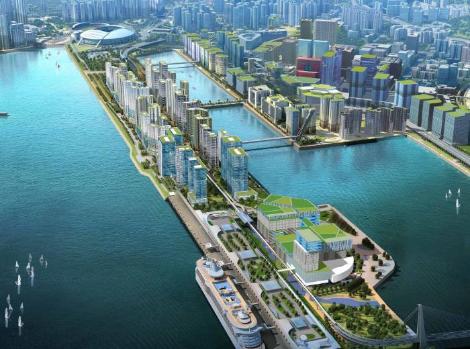
In hot and humid Hong Kong, the demand for cooling is rising alongside global temperatures, but in the new Kai Tak Development a low-carbon district cooling system is keeping residents cool.
The system uses seawater to supply 284 MW of centralised cooling to everything from schools and hotels to shopping centres and railway stations, achieving 35% greater efficiency than standard air-cooling systems.
On the site of the old Kai Tak airport, Hong Kong is building its second central business district, with a district cooling system at the heart of its future-proofing strategy. In a city where air conditioning constitutes 30% of electricity demand, the centralised system – which uses seawater from the surrounding Kowloon Bay – is expected to achieve an annual saving of 85 million kWh of electricity upon completion. This is equivalent to an emission reduction of 59,500 tonnes of CO2 annually.
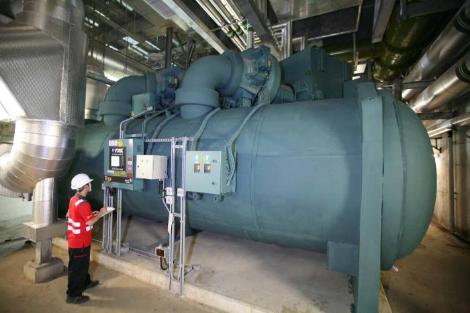
More than 39 km of leak-detection piping will pump coolant from two central chillers to almost two million square metres of floor space. Load diversity is achieved thanks to the multiple uses of the spaces being cooled, making the system more resilient as peak demand differs from location to location.
For building owners and residents alike, the benefits of the system stretch far beyond the reductions in CO2 emissions. In the construction phase, developers save on capital costs for cooling equipment, and pay competitive rates for cooling over the life of the building. Additionally, without the pollution, noise, and space taken up by conventional cooling units, residents can enjoy a more spacious and livable district.
This is one of the 100 solutions highlighted in the 2019 edition of Cities100. Now in its fourth year, Cities100 provides recognition for 100 of the boldest projects from cities around the world which are working to address climate change and build a better, greener future. The publication highlights solutions that are replicable and scalable, and which reduce emissions and address the issues that cities face as a result of climate change. Read the Cities100 report, by C40 and Nordic Sustainability, for full details.
Hong Kong’s advice for other cities
Use the resources on your doorstep
The use of seawater, which surrounds Kai Tak, is key to the project’s ability to reduce costs and carbon emissions. It goes to show that sustainable solutions are sometimes right in front of us, if we are open to inspiration.
Invest in infrastructure using long-term financing plans
While the initial funding for the project comes from Hong Kong’s government, tariffs charged to building owners for cooling shall recover the capital and operating costs over a 30-year lifetime. This means that taxpayers don’t foot the bill in the long term and building operators receive affordable cooling services.
Wider benefits
Social: Kai Tak’s district cooling system frees up large amounts of rooftop space by removing the need for individual HVAC units, allowing the architects to think more creatively, designing roof gardens and green roofs that act as social spaces.
Health: The switch from traditional HVAC systems not only improves local air quality, it also reduces the urban heat island effect as well as reducing vibration and noise pollution, which can create health risks for Kai Tak’s population.
Economic: As the upfront costs of the district cooling system are paid by the city government, building owners face reduced capital costs during the construction phase.
Environmental: Compared to air-cooled systems, the district cooling system will result in an annual reduction in CO2 emissions of 59,500 tonnes. Additionally, by freeing up roof space, the district is able to have 30% coverage of greenery - a much higher rate than the average across the rest of the city.
Sources
Online document: Cities100: Hong Kong’s seawater-based district cooling system
To go further
Website:www.c40.org/