Forests: the landscape’s natural sponges
Selecting, designing and implementing Natural Water Retention Measures in Europe (MNRE) : forestry
European Commission, febrero 2023
Forests, which cover 40 per cent of Europe’s land area, play a major role in regulating the water cycle. Thanks to their high infiltration capacity, dense vegetation cover and soils rich in organic matter, they act as natural sponges, capable of storing, filtering and gradually releasing water. However, deforestation, clear-cutting and unsustainable management practices have often weakened these hydrological functions.
Natural Water Retention Measures (NWRM) in forestry aim to restore and optimise these capabilities. Whether through the creation of wooded riparian buffer zones, the maintenance of forest cover upstream of watercourses, or targeted afforestation, these practices help to reduce the risk of flooding, improve water quality and enhance biodiversity. They are in line with the objectives of the Water Framework Directive, the Floods Directive and the European Biodiversity Strategy.
What if the forest of the future were one that, rather than just producing timber, also produced water ?
This factsheet summarises the topic ‘Forestry’ from the document ‘Selecting, Designing and Implementing Natural Water Retention Measures in Europe (MNRE)’. See the three other factsheets on: Agriculture, Hydromorphology, Urban
Para descargar: mesures-naturelles-de-retention-deau-en-europe_fr.pdf (8,4 MiB)

The issues : Why must forestry incorporate water management ?
Poorly managed forests can exacerbate water-related problems : soil compaction caused by forestry machinery, reduced infiltration following clear-cutting, or increased erosion on deforested slopes. Conversely, sustainable management helps to :
-
Slow down runoff thanks to the roughness of the vegetation cover and the forest floor.
-
Filter out pollutants (nitrates, phosphates, heavy metals) before they reach watercourses.
-
Stabilise slopes and limit landslides, particularly in mountainous areas.
In Europe, the headwater areas of watercourses (F2)1 are particularly strategic: afforestation in these areas can reduce flood peaks and improve water quality downstream. However, these areas are often under-utilised or converted to agricultural land, which exacerbates water-related risks.
NWRM solutions for resilient forestry
Protecting watercourses and sensitive areas
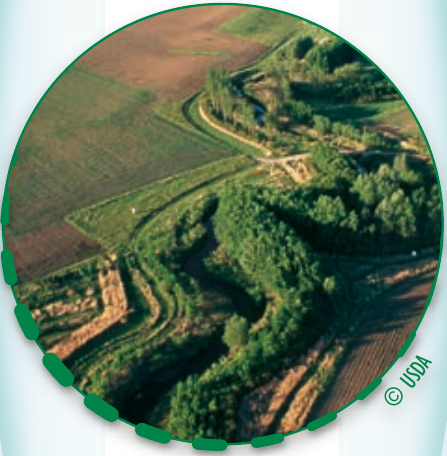
Wooded riparian buffer zones (F1) are one of the most effective measures for protecting watercourses. These strips of woodland, situated along the banks of rivers or lakes, act as natural filters: they trap sediment, reduce nitrate leaching (by up to 90 per cent following clear-cutting), and provide habitats for aquatic wildlife. Their ideal width ranges from 2 to 20 metres, and their effectiveness is proportional to their size.
Case study: In Pickering (United Kingdom), the creation of forested buffer zones has helped to slow down river flow and reduce the risk of downstream flooding, whilst restoring riparian ecosystems.
Maintaining forest cover in the upstream areas of watercourses (F2) is another key measure. Forests at the headwaters of catchment areas, thanks to their high rate of evapotranspiration and highly permeable soil, reduce the volume of water contributing to runoff. They also play a major role in stabilising slopes and preventing landslides, as observed in the Alps and the Pyrenees.
Adapting forest management to conserve water
Permanent forest cover (F6) avoids clear-cutting and maintains a continuous vegetation cover, thereby limiting erosion and sediment production. This practice also enhances carbon sequestration and biodiversity, whilst reducing flood peaks through improved infiltration.
‘Water-sensitive’ management (F7) aims to minimise the impact of forestry machinery on wet soils. By avoiding driving on waterlogged or frozen ground, it reduces rutting and compaction, thereby preserving soil structure and its infiltration capacity. This measure is particularly important in areas of peatlands or fragile soils.
Case study : In Orség National Park (Hungary), the implementation of water-sensitive operations has helped to limit the mobilisation of mercury in the soil, thereby protecting aquatic ecosystems.
Restoring the hydrological functions of forests
Sedimentation basins (F9), installed within forest ditch networks, slow down water flow and encourage sediment deposition. They are particularly useful for managing the impacts of forestry operations (road construction, felling) and reducing diffuse particulate pollution.
Peak flow control structures (F13), designed to limit flow in forest ditches, reduce flood peaks and control sediment transport. They are often combined with other measures such as surface runoff areas (F14), which collect excess sediment produced during ditch maintenance.
Case study : In the Belford catchment (United Kingdom), the installation of sedimentation basins and control structures has significantly reduced the sediment load in downstream watercourses.
Integrating forests into urban and peri-urban areas
Urban forest parks (F11) and trees in urban areas (F12) play an increasingly important role in stormwater management. Their soils, which are more permeable than hardened surfaces, promote infiltration and groundwater recharge. They also reduce the heat island effect and improve air quality by trapping air pollutants.
Case study : The Kylmaojankorpi wooded wetland (Finland) demonstrates how urban forests can store large quantities of water whilst providing recreational spaces and enhancing biodiversity.
Implementation : Challenges and opportunities
NWRM measures in forestry apply at several scales :
-
Local : Buffer zones (F1), water-sensitive management (F7).
-
Landscape : Permanent forest cover (F6), afforestation of upstream catchments (F2).
-
Regional : Networks of ditches with sedimentation basins (F9), flow control structures (F13).
Costs and funding :
-
Wooded riparian buffer zones (F1) generally do not involve land acquisition costs, but may result in a loss of income (uncultivated land).
-
Afforestation of upstream catchments (F3) may require significant investment (planting, maintenance), but this is often offset by the hydrological benefits (reduced flood risk, improved water quality).
-
Flow control structures (F13) vary in cost depending on the materials used (wood, stone, concrete), but their lifespan and benefits (reduction in flood peaks) justify the investment.
Barriers and drivers :
-
Barriers : Resistance to change, initial costs, land tenure complexity (private land ownership).
-
Drivers : Grants (European programmes such as LIFE), awareness-raising (feedback on experiences), valuing ecosystem services (payments for water retention).
Multiple benefits : Beyond water management
NWRM measures in forestry generate a cascade of positive effects :
-
Climate : Growing forests sequester CO₂ (up to several tonnes per hectare per year) and mitigate the effects of climate change.
-
Biodiversity : Buffer zones (F1) and sustainably managed forests provide habitats for numerous species (birds, mammals, insects).
-
Economy : Reducing flood risks and improving water quality generate savings for local authorities and businesses.
-
Social : Urban forests (F11, F12) improve the quality of life and provide recreational spaces.
Conclusion : Towards forestry that works in harmony with water
Natural Water Retention Measures in forestry demonstrate that forest management and water management can go hand in hand. Drawing inspiration from natural ecosystems, these practices offer sustainable and multifunctional solutions to :
-
Reduce the risk of flooding by slowing down runoff.
-
Improve water quality by filtering out pollutants.
-
Enhance biodiversity and ecosystem services.
-
Combat climate change through carbon sequestration.
To ensure their widespread adoption, it is essential to :
-
Raise awareness amongst forest managers and landowners.
-
Simplify access to funding (grants, payments for ecosystem services).
-
Integrate these measures into forestry policies (management plans, regional schemes).
What if the forest of the future were one that, as well as producing timber, also provided water, biodiversity and climate benefits ?
1 : see the summary on forestry (in French) : F1 – Wooded riparian buffer zones – F2 – Maintenance of forest cover in upstream areas of watercourses – F3 – Afforestation of reservoir catchment areas – F4 - Targeted planting to ‘ capture ’ rainfall - F4 - Targeted planting to ‘ capture ’ rainfall - F5 - Land-use conversion - F6 - Permanent forest cover - F7 - ‘ Water-sensitive ’ management - F8 - Appropriate design of roads and watercourse crossings - F9 - Sedimentation basins - F10 - Coarse woody debris - F11 - Urban forest parks - F12 - Trees in urban areas - F13 - Peak flow control structures in managed forests - F14 - Surface runoff areas in peatland forests
Referencias
-
European Commission document : Selecting, designing and implementing Natural Water Retention Measures in Europe (MNRE),
available on the website : www.sgle.fr/wp-content/uploads/2024/02/Mesures-naturelles-de-retention-deau-en-Europe_compressed.pdf
-
Website : Syndicat Grand Lieu Estuaire
Para ir más allá
-
NWRM Project : nwrm.eu/measures-catalogue
-
Water Framework Directive : European Commission website
-
European Forest Network : ec.europa.eu/environment/forests/