Experiences from regions in transition: the Grands Causses Regional Nature Park
A model of consistency and efficiency
May 2021
Territoires à Energie Positive (TEPOS)
Located in southern Aveyron, the Grands Causses Park (70,000 inhabitants, 93 municipalities) has been embodying an ambitious and integrated energy transition since 2007. Driven by strong political will, this rural area has transformed energy into a catalyst for local development, combining economic attractiveness, the optimisation of resources and community engagement.
With an initial target of 100 per cent renewable energy by 2030, the Park has exceeded expectations and now aims to contribute to regional and national targets. Its approach is based on a cross-cutting strategy, in which energy is integrated with spatial planning (SCoT), climate planning (PCAET) and practical tools for local stakeholders. Collaboration and coordination between inter-municipal bodies play a key role here, making this area a model of coherence and efficiency.
To download : porter-un-projet-de-territoire-en-transition-2021_fr.pdf (4.3 MiB)
A cross-cutting approach that has been gaining momentum for the past 15 years
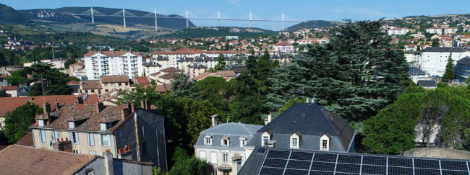
Established in 1995 in southern Aveyron, the Grands Causses Regional Nature Park is home to 70,000 inhabitants across 93 local authorities, with an average population density of fewer than 20 inhabitants per km². In 2007, when renegotiating its charter, the Park embarked on an Agenda 21 initiative with a focus on the energy transition and the balanced development of renewable energies. Whilst energy issues took centre stage in 2008 with the Grenelle Environment Forum, the Park decided to be more ambitious: it launched a voluntary territorial climate and energy plan, with the aim of transforming the prevailing local mindset, which was based on the idea that ‘energy is a matter for the State’. Having gradually built up its momentum, from 2015 onwards the Parc des Grands Causses benefited from a range of funding opportunities (the government’s TEPCV call for projects, a territorial objectives contract signed with ADEME, European and regional funds, etc.) which enabled it to strengthen its human resources, its practical actions and its links with local authorities.
A region committed to solidarity and contributing to regional and national objectives
Initially, the Park set itself the ambitious target of achieving energy self-sufficiency with 100 per cent renewable energy by 2030. The results observed over recent years show that the region is on track to achieve this and is even progressing faster than anticipated. This is why the new Territorial Climate, Air and Energy Plan (PCAET), approved in 2019, has raised the bar: the Parc des Grands Causses now aims to become a region that fosters solidarity and contributes to regional (‘Occitanie: a positive-energy region’) and national objectives.
Energy: a key local policy
The Park approaches energy as a key local policy, on a par with the economy, spatial planning, etc. To this end, it mobilises all the resources at its disposal (strategy, planning, contracts, etc.), and does not limit itself to addressing specific, isolated issues or taking ad hoc action. By giving the energy issue a holistic perspective in this way, multiple drivers of political action are set in motion simultaneously: economic development, local employment, the utilisation of local resources, attractiveness to new residents, resident ownership and mobilisation, etc. By establishing the issue as a political priority, the Park recognises the need to allocate the necessary resources. The Park’s structure, which naturally facilitates territorial planning, is conducive to this.
An energy strategy underpinned by the spatial planning strategy
The Park draws on its Territorial Coherence Scheme (SCoT) to consolidate its strategy for spatial planning and sustainable development, and to lend credibility to and support its ambitious energy transition objectives. The Park’s assumption of SCoT responsibilities enables it to take the lead on the PCAET in place of the communities of communes, which have (quite naturally) transferred this responsibility to it. The result of extensive consultation and persuasion, the SCoT was adopted unanimously, reflecting the bond of trust the Park has established with local authorities and regional stakeholders, as well as the high level of general buy-in on energy issues. The objectives set out in the SCoT’s policy and objectives document, particularly those relating to energy, are gradually being incorporated into the town and district planning documents, thereby amplifying the strategy’s impact. The PCAET, which was unanimously approved at the end of 2019, is also being implemented at the inter-municipal level, in order to ensure consistency with the numerous initiatives already carried out at this level.
A tool for setting the framework for project implementation
Elected representatives sought to provide a framework for the (sometimes questionable) practices involved in developing large-scale renewable energy projects by taking back control, providing direction and raising awareness; in doing so, they have shifted from a ‘defensive’ regulatory stance to a proactive approach to supporting the energy transition. The SCoT sets out the conditions for implementing the energy transition that are acceptable to elected representatives (and, more broadly, the region), with a view to local development. The SCoT includes a plan identifying areas suitable for the development of wind farms and solar power stations, taking into account issues relating to the electricity grid. It promotes and provides a framework for the development of the wood-energy and anaerobic digestion sectors. It proposes that local authorities and citizen-led initiatives should be granted widespread access to equity in companies operating wind farms and other renewable electricity generation facilities (over 250 kW), up to a 35 per cent stake. Whilst not legally binding, this provision carries political weight and encourages developers to position themselves as promoters of projects of regional interest.
Joint management of the regional development plan
As a central component of a regional development plan that sets a clear course (the Park’s charter), the energy transition is subject to joint management, enabling effective administration and monitoring. The Park’s governance involves numerous stakeholders, starting with the inter-municipal bodies. Strategic directions are the subject of broad consultation, and regional partners meet annually to review progress. The implementation of the charter (objectives, actions, budgets, progress reports) is monitored and evaluated using a single tool. This applies in particular to the SCoT and the PCAET. When the State proposed that the Park sign an ecological transition contract, it committed itself swiftly and effectively. It identified a number of key actions – not yet fully funded – that form part of its energy strategy, and brought together the relevant stakeholders to provide the impetus. The Roquefort positive-energy sector project is one such initiative.
The Park has internally moved from rhetoric to solutions, which local elected representatives wish to see implemented swiftly: it prioritises projects that meet the region’s needs and the implementation of concrete, operational tools. Pooling resources lies at the heart of the Park’s proposals: awareness-raising and engagement activities; technical and administrative support (in-house or external) for various target groups; the provision of studies and regional tools that can be used locally; joint commissioning of studies and works; and the creation of regional operators… The majority of inter-municipal bodies and a great many local authorities, which do not have an engineering department like the Park’s, rely on its proposals, recognising them as a means of achieving efficiency and as being in line with the region’s interests – all the more so as the Park is very mindful of respecting their respective areas of competence.
The benefits of the initiative
-
The political ambition to become a region that contributes to regional and national objectives, exporting energy beyond its own needs.
-
Energy approached as a local, cross-cutting and structuring public policy.
-
The SCoT’s leadership of the PCAET, which enables energy and spatial planning strategies to be integrated.
-
Pooling resources as a means of scaling up the transition to action across the whole region.
Timeline of key milestones :
-
In 2000, the first private wind power projects.
-
In 2007, revision of the charter (recognised as Agenda 21 in 2010) and a political commitment to an energy and climate action plan. A territorial agreement (State-Region project contract) was signed for three years, funded by the Region.
-
2007–2013: Leader programme ‘ Les Grands Causses facing the challenges of climate change ’ (European funding over six years).
-
2009: launch of the PCET (Territorial Climate and Energy Plan) with the recruitment of an energy and climate project officer. Actions : raising public awareness; energy management in public buildings.
-
In 2012, the Park assumed responsibility for the ScoT (Territorial Cohesion Scheme).
-
In 2014–2020, a new Leader programme (6 years) with a dedicated coordinator, focusing on mobility.
-
In 2015, TEPCV (State) : energy-efficient refurbishment of social housing, micro-hydroelectricity projects, sustainable mobility initiatives. A single territorial contract (Region, 3 years) funds strategic initiatives.
-
In 2016, a renewable energy targets contract (ADEME, 3 years) : establishment of the SEM Causses Energia, with a wood-energy project manager and a mobility project manager.
-
In 2017, a rural development contract (Central Government: DSIL, DETR, FNADT) for territorial initiatives. Decision to implement the PCAET via the SCoT. In 2018, France Mobilités (ADEME) and Leader (Europe): sustainable mobility initiatives with a mobility project manager (renewal). A single regional contract (Region, 3 years) was signed.
-
In 2018, a shared energy advisory service was set up (ADEME, 3 years) with an energy adviser. Initiatives : energy-efficient refurbishment of public buildings, partial switch-off of street lighting, development of clusters of solar power projects.
-
In 2019, PCAET : development and coordination of the strategy via Destination TEPOS (carried out in-house). Regional food plan (Ministry of Agriculture) to structure the local agricultural sector.
-
In 2020, Ecological Transition Contract : the ‘Roquefort’ positive-energy sector, energy-efficiency refurbishment platform.
-
In 2021, Rénov/Occitanie helpdesk (Region) : 2 energy advisers to support the refurbishment of private housing. Sustainable Tourism (ADEME) : support for tourism businesses.
Sources
Tepos document : Leading a regional transition project (French version) ; extract from pages 32–35