The integrated water cycle at Googong (Australia)
Circular and resilient water management in urban areas
agosto 2025
ICLEI-Local Governments for Sustainability
In Googong, Australia, a new town has been designed from the outset to incorporate a fully sustainable water cycle, combining resilience, innovation and quality of life.
This project, which combines dual networks, rainwater harvesting and the reuse of treated wastewater, demonstrates how ambitious urban planning can transform a town into a model of circular water management.
Driven by a collaboration between developers, local authorities and residents, this project illustrates how water can become a driver of sustainable development for modern communities.
This factsheet summarises one of the 12 case studies in the document: Circular and Resilient Urban Water Management
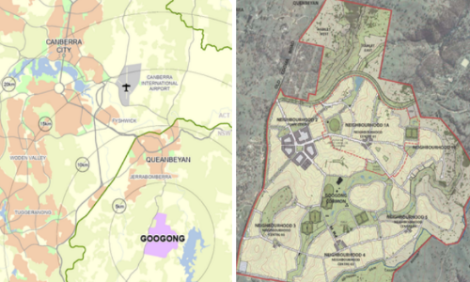
Googong is a new town under development in the New South Wales region of Australia. Designed to accommodate 55,000 residents in the long term, the town was conceived from the outset to incorporate a fully sustainable water cycle, addressing the challenges of water shortages, pressure on natural resources and the need for resilient solutions for a growing community. In a temperate climate, with hot summers and moderate rainfall, Googong needed to find innovative ways to manage water sustainably, whilst offering a high quality of life to its residents.
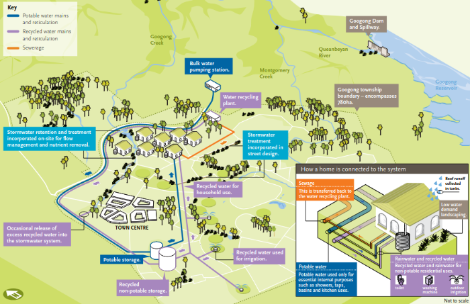
Googong’s integrated water cycle is an innovative system combining dual networks, rainwater harvesting and the reuse of treated wastewater. Developed in collaboration with local authorities, property developers and water management experts, this project aims to create a water-self-sufficient town, where every drop is optimised for sustainable use. The objective is to reduce demand for drinking water by 50 per cent, whilst ensuring a reliable supply for essential needs.
Solutions implemented
-
Dual networks : Separation of drinking and non-drinking water for optimised management. Non-drinking water is used for purposes that do not require drinking-quality water, such as irrigation or flushing toilets.
-
Rainwater harvesting : Integrated into residential buildings, public spaces and urban infrastructure. Rainwater is collected, stored and reused for non-potable purposes.
-
Reuse of treated wastewater : Wastewater is treated locally and reused for the irrigation of green spaces, flushing toilets and other non-potable uses.
-
Green infrastructure : Retention basins and ecological corridors are integrated into the city for sustainable stormwater management.
Key results
-
50 per cent reduction in drinking water demand : Through the reuse of treated wastewater and rainwater harvesting, the town has been able to reduce its reliance on freshwater resources.
-
Improved resilience to droughts : The integrated system enables the town to better withstand periods of water restrictions, ensuring a reliable supply for essential needs.
-
Creation of a sustainable town : Googong has become a model for future urban projects in Australia and internationally, demonstrating how integrated planning can reconcile urban development with sustainable water management.
-
Social acceptance : Raising awareness and involving residents has enabled the rapid adoption of new water management practices.
Climate and environmental impacts
-
Climate change mitigation :
- Reducing demand for drinking water lowers energy consumption associated with pumping, treating and transporting water, thereby reducing CO₂ emissions.
- Green infrastructure (retention basins, ecological corridors) helps to reduce the urban heat island effect, thereby improving thermal comfort and reducing energy consumption associated with air conditioning.
-
Climate adaptation and resilience :
- Drought management : The integrated system ensures a continuous water supply even during periods of water restrictions, thereby guaranteeing the city’s resilience in the face of prolonged droughts.
- Flood mitigation : Retention basins and ecological corridors help manage stormwater, thereby reducing the risk of flooding.
-
Biodiversity : Green spaces and ecological corridors provide habitats for local flora and fauna, contributing to the restoration of urban ecosystems.
Success factors
-
Values :
- Integrating sustainability from the very outset of the city’s design, with a holistic approach that combines water management, climate resilience and quality of life.
- Recognising the importance of community participation to ensure the project’s long-term success.
-
Connections :
- Physical connections : Dual networks, rainwater harvesting systems and green infrastructure create an integrated system where water is managed efficiently and sustainably.
- Social connections : Collaboration between property developers, local authorities and residents to design a city tailored to local needs.
-
Investments :
- Blended finance : The project has benefited from public and private funding, with long-term economic returns thanks to savings made on water consumption.
- Sustainable economic model : Savings on water and energy costs enable rapid amortisation of the initial investments.
Replicability in Morocco
The Googong model could inspire new Moroccan towns, such as Zenata (near Casablanca) or satellite town projects around Rabat or Tangier. By incorporating dual networks, rainwater harvesting systems and green infrastructure, these towns could become models of sustainability in North Africa.
For example, in Zenata, where an eco-city is currently being developed, adopting this model would help reduce demand for drinking water whilst improving the region’s climate resilience. Similarly, in tourist areas such as Marrakesh, this system could help manage water resources sustainably, whilst raising visitors’ awareness of responsible water management.
Referencias
Online document, see pages 82 to 97 : Gestion circulaire et résiliente de l’eau en milieu urbain - Circular and resilient water management in urban areas
Para ir más allá
Websites : iclei.org/ & iclei-europe.org/
Bibliography
1. Bureau of Meteorology. (n.d.). Climate statistics for Australian locations [Statistiques climatiques pour les localités australiennes] : Queanbeyan Bowling Club (Site 070072). Gouvernement australien. www.bom.gov.au/climate/averages/tables/cw_070072.shtml
2. CIC Australie. (avril 2025). Projet de cycle intégré de l’eau à Googong : questions fréquemment posées. Googong Township Pty Ltd. googong.net/wp-content/uploads/sites/91/2025/04/FAQ.pdf
3. CIC Australia. (Avril 2025). Projet de cycle de l’eau de la commune de Googong. Googong. googong.net/wp-content/uploads/sites/91/2025/04/Googong-township-water-cycle-project.pdf
4. Département de la planification et des infrastructures. (2011). Projet sur le cycle de l’eau de la commune de Googong : rapport d’évaluation environnementale du directeur général (MP08_0236).Gouvernement de Nouvelle-Galles du Sud. majorprojects.planningportal.nsw.gov.au/prweb/PRRestService/mp/01/getContent?AttachRef=MP08_0236%2120190807T055615.800+GMT
5. Googong Township Pty Ltd. (30 juillet 2013). Lancement d’un système de recyclage de l’eau de 90 millions de dollars à Googong. www.googong.net/updates/90-million-water-recycling-system-launched-at-googong/
6. Googong Township Pty Ltd. (23 octobre 2020). L’eau recyclée à Googong. www.googong.net/updates/recycled-water-at-googong/
7. Googong Township Pty Ltd. (avril 2025). Projet de cycle intégré de l’eau à Googong : invitation à commenter les travaux d’extension de la phase D. googong.net/wp-content/uploads/sites/91/2025/04/Googong_IWC_Project.pdf
8. Googong. (s.d.). À propos de Googong. www.googong.net/about/
9. Mirvac Group. (avril 2025). Googong, Googong Dam Road. www.mirvac.com/search#global-search_q=Googong&global-search_e=0
10. Morgan, N. (23 janvier 2023). Points forts de la visite technique d’ACT. Australian Water Association. www.awa.asn.au/resources/latest-news/act-technical-tour-highlights
11. Nowroozi, I. (5 décembre 2020). L’usine de recyclage de l’eau de Googong est pleinement opérationnelle alors que Canberra est appelée à développer des options plus durables. ABC News. www.abc.net.au/news/2020-12-06/googong-water-recycling-plant-puts-pressure-on-canberra/12954722
12. OpenLot. (s.d.). Googong, NSW 2620. www.openlot.com.au/googong-nsw-2620
13. Conseil régional de Queanbeyan-Palerang. (10 août 2017). Norme de plomberie de Googong. www.qprc.nsw.gov.au/files/assets/public/v/1/services/water-amp-sewer/googong_plumbing_standard_10_august_2017.pdf
14. Conseil régional de Queanbeyan-Palerang. (10 août 2017). Comment fonctionne le système intégré de cycle de l’eau ? www.qprc.nsw.gov.au/files/assets/public/v/1/services/water-amp-sewer/booklet-recycled-water-in-googong-final-web.pdf
15. Conseil régional de Queanbeyan-Palerang. (s.d.). Fiche d’information 01 : Comment fonctionne le système intégré de cycle de l’eau ? www.qprc.nsw.gov.au/files/assets/public/v/1/services/water-amp-sewer/fact-sheet-01-how-does-the-integrated-water-cycle-system-work.pdf
16. Conseil régional de Queanbeyan-Palerang. (s.d.). Eau recyclée de Googong. www.qprc.nsw.gov.au/Services/Water/Googong-Recycled-Water
17. Ross, K. (28 août 2024). Googong : le nouveau centre commercial de cette communauté planifiée de 1,8 milliard de dollars recherche des investisseurs. Immobilier commercial. www.commercialrealestate.com.au/news/googong-1-8b-masterplanned-communitys-new-convenience-centre-seeks-investors-1314517/18. Stantec. (s.d.). Cycle intégré de l’eau de la commune de Googong. www.stantec.com/au/projects/g/googong-township-integrated-water-cycle
19. Wong, C. H., Hurley, K., & Harris, C. (2017). Construire une ville résiliente face à l’eau. Association australienne de l’eau. www.awa.asn.au/resources/latest-news/environment/built-environment/building-a-water-resilient-town
20. Wong, C. H., Hurley, K., & Harris, C. (16 août 2017). Construire une ville résiliente face à l’eau. Association australienne de l’eau. www.awa.asn.au/resources/latest-news/environment/built-environment/building-a-water-resilient-town