La Quebradora Hydropower Station (Mexico)
Circular and resilient water management in urban areas
agosto 2025
ICLEI-Local Governments for Sustainability
In Iztapalapa, one of Mexico City’s most vulnerable neighbourhoods, La Quebradora Water Park has transformed a piece of unused land into a multifunctional public space, combining flood management, groundwater recharge and environmental education. Designed as a demonstration of ‘urban hydro-acupuncture’, this innovative project shows how targeted interventions can transform a city’s water resilience, whilst providing green and recreational spaces for residents. Driven by a collaboration between the local council, the university and civil society, this park has become a symbol of community resilience and urban sustainability.
This factsheet summarises one of the 12 case studies in the document: Circular and Resilient Urban Water Management
Iztapalapa, one of Mexico City’s 16 boroughs, is one of the city’s most densely populated and vulnerable neighbourhoods, with a population of 1.835 million (2020). Its high-altitude subtropical climate (860 mm of annual rainfall) leaves it prone to frequent flooding caused by heavy rains from the neighbouring Sierra de Santa Catarina mountain range, whilst it suffers from chronic water shortages due to overcrowding and a lack of urban planning. Although water is supplied from other catchment areas, infrastructure failures result in high distribution losses, forcing many residents to rely on water delivered by tankers – a costly and unreliable temporary solution.
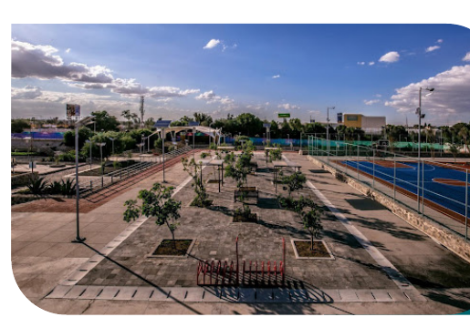
La Quebradora Water Park (or Utopía Atzintli) is a pilot project in ‘urban water acupuncture’, designed to transform an unused plot of land into a multifunctional public space. Developed by the municipality of Iztapalapa, Mexico City’s public spaces authority and the National Autonomous University of Mexico (UNAM), this 3.8-hectare park combines flood management, groundwater recharge and wastewater treatment with the creation of recreational and educational spaces for the community. The project was launched in 2013, with detailed design completed in 2017 and construction beginning in 2018. Despite setbacks due to insufficient funding and political changes, international recognition (notably the LafargeHolcim Global Gold Prize) helped to revive the project, which was inaugurated in 2021.
Solutions implemented
-
Development of a public park and community facilities : The park includes a library, a swimming pool, a bookshop, workshops, leisure areas and a community centre, thus providing a vibrant hub for local residents.
-
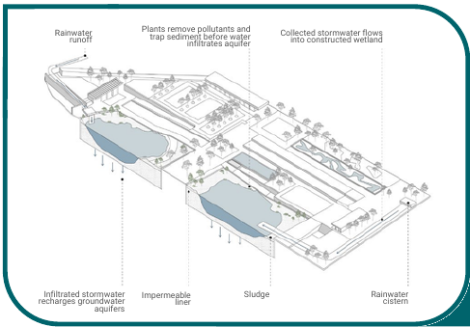
Stormwater drainage channels : These channels divert rainwater from neighbouring areas to the park, where it is filtered through screens and absorbed by permeable basins, thereby helping to recharge the water table.
-
Rainwater collection and storage : Through the use of terraces, wetland systems and cisterns, the park collects and stores water for later use.
-
Wastewater treatment and reuse : An anaerobic biological treatment plant and an underground wetland treat wastewater from a nearby drainage channel. The treated water is reused to meet the park’s daily needs and to supply the pavilion’s facilities, where local residents can come to fill their water containers.
-
Sustainable landscaping : Replacement of water-intensive lawns with dry landscaping requiring no irrigation and with native or endemic tree species requiring small amounts of water.
Key results
-
Flood mitigation and groundwater recharge : The initiative increased water catchment capacity by 35 per cent, resulting in an infiltration rate of approximately 68,000 m³/year, recharging groundwater to a total capacity of 36,000 m³. Improved filtration and sedimentation enhance water quality, promote aquifer recharge and ensure long-term security of water supply.
-
Stormwater management and rainwater harvesting : The 3.8 ha catchment area collects runoff from the mountains, recharges the underlying aquifer and harvests approximately 86.4 m³/day of rainwater for park maintenance and toilet flushing.
-
Accessible public spaces and urban facilities : The project benefits 28,000 residents, doubling the amount of public space available in Iztapalapa from 1.13 to 2.97 m² per person and attracting around 7,000 visitors per week.
-
Increased vegetation cover : The number of trees in the area has tripled thanks to this initiative to plant native species.
Climate and environmental impacts
-
Climate change mitigation : Localised groundwater recharge and rainwater harvesting systems offer a sustainable alternative to large-scale, costly and high-carbon ‘grey infrastructure’ designed to transport water over long distances from Cutzamala.
Replacing water tankers with community water points also helps to reduce greenhouse gas emissions and improve air quality.
-
Climate adaptation and resilience :
₋ Flood risk mitigation : Permeable basins, artificial wetlands and cisterns enable local management of rainwater, thereby reducing the risk of flooding in critical areas such as Ermita Iztapalapa Avenue, a major thoroughfare for motorists and public transport.
₋ Tackling water scarcity : Rainwater collection and treatment systems provide non-potable water for irrigation and sanitation. Permeable basins help to recharge aquifers, enabling the sustainable use of groundwater by local communities.
-
Biodiversity : Footpaths offer multiple routes across the 3.8-hectare site, allowing wildlife to move freely throughout the area. The park is also home to a wide variety of endemic or locally adapted plant species, which has helped to triple the tree cover in the region.
Success factors
-
Values : The project embodies the principles of hydro-urban acupuncture, which advocates targeted, hyper-local and small-scale interventions capable of systematically improving water management without requiring changes to town planning schemes or large-scale redevelopment. It also draws inspiration from elements of the ‘sponge city’ concept, transforming public space into hydrological and educational infrastructure : a place that is at once aesthetic, functional and educational, where water regains its place at the heart of the urban landscape.
-
Connections :
₋ Physical connections : The park channels urban runoff from the Sierra de Santa Catarina towards infiltration basins, thereby creating an integrated network to recharge local aquifers and supply water to public drinking fountains.
₋ Social connections : Thanks to a participatory design model, the project has enjoyed consistent support from all stakeholders, strengthening ties between the local community, civil society, academia and local authorities.
-
Investment : La Quebradora demonstrates the feasibility of a funding model for circular and resilient water infrastructure through multi-level investment, drawn from national and local public funds as well as private donors. By combining stormwater management infrastructure with high-quality public spaces, La Quebradora presents an attractive investment opportunity for public authorities and other stakeholders.
Replicability for Morocco
La Quebradora represents a replicable model for sustainable urban water management in Mexico and beyond. The project has inspired adaptations in other municipalities such as Ecatepec, Tijuana (Mexico) and Nogales (Arizona, USA) through projects combining flood control, water reuse and the development of public spaces.
This concept also offers significant potential for replication in Morocco. Its ‘hydro-urban acupuncture’ strategy could be particularly relevant for Moroccan cities seeking to improve water circularity and resilience in dense urban environments, where large-scale infrastructure projects might require costly urban redevelopment. The La Quebradora model, which integrates groundwater recharge and stormwater management into public spaces, also serves as a valuable benchmark for Morocco’s peri-urban areas seeking to implement localised, low-cost and multifunctional infrastructure.
In Tetouan, for example, where informal settlements around the Martil river basin are vulnerable to rainwater runoff from the neighbouring hills, the creation of terraced public spaces, infiltration areas and similar decentralised retention basins would both improve the management of water flows and enhance the quality of the urban environment.
Referencias
Online document, see pages 41 to 52 : Gestion circulaire et résiliente de l’eau en milieu urbain - Circular and resilient water management in urban areas
Para ir más allá
Websites : iclei.org/ & iclei-europe.org/
Bibliography :
1. Archiabyssniya. (29 juin 2024). La Quebradora Water Park in Mexico: Designing public spaces to improve water management (Parc aquatique La Quebradora au Mexique : concevoir des espaces publics pour améliorer la gestion de l’eau). archiabyssniya.wordpress.com/2024/07/15/la-quebradora-water- park-in-mexico-designing-public-spaces-to-improve-water-management/
2. Congreso de la Ciudad de México (Congrès de la ville de Mexico). (24 octobre 2018). Propuesta con punto de acuerdo de urgente y obvia resolución por el que se solicita respetuosamente a la Secretaría de Finanzas de la Ciudad de México y al Sistema de Aguas de la Ciudad de México, a que en el ámbito de sus atribuciones, envíen un informe a esta soberanía sobre el proyecto « Parque Hídrico La Quebradora » www.congresocdmx.gob.mx/archivos/parlamentarios/PPA_20_23_25_10_2018.pdf.
3. Conrad, P., & Voraakhom, K. (18 novembre 2024). WORKS with Nature: Low Carbon Adaptation Techniques for a Changing World. United Nations Framework Convention on Climate Change (WORKS with
Nature : Techniques d’adaptation à faible émission de carbone pour un monde en mutation. Convention-cadre des Nations unies sur les changements climatiques). unfccc.int/sites/default/files/resource/WORKS-with-Nature-Low-Carbon-Adaptation-Techniques- for-a-Changing-World.pdf
4. Gaceta de Iztapalapa. (24 janvier 2018). Desarrollo del Parque Hídrico La Quebradora podría significar el inicio del cambio en el tratamiento del agua de lluvia. gacetadeiztapalapa.com.mx/desarrollo-del- parque-hidrico-la-quebradora-podria-significar-el-inicio-del-cambio-en-el-tratamiento-del-agua-de-lluvia/
5. Giuroiu, A. (27 janvier 2025). Parque Hídrico La Quebradora: Transforming water management and public space in Mexico City. (Parque Hídrico La Quebradora : Transformer la gestion de l’eau et l’espace public à Mexico). Architecture Lab. www.architecturelab.net/parque-hidrico-la-quebradora
6. Fondation Holcim. (Juin 2020). Flooding and thirst: Addressing an urban hydrology crisis. (Inondations et soif : faire face à une crise hydrologique urbaine). Fondation Holcim. www.holcimfoundation.org/media/news/projects/flooding-and-thirst Aerial view of Dadingling
7. Instituto Nacional de Estadística y Geografía (INEGI). (15 décembre 2020). Censo Forest de Park Población ca. 2021. y Vivienda 2020 : Resultados rápidos – Iztapalapa. Source: Thornett (2023). www.inegi.org.mx/app/cpv/2020/resultadosrapidos/default.html
8. Kramer, A. (2022). Managing the invisible: Trends in sustainable groundwater development (Gérer l’invisible : tendances en matière de développement durable des eaux souterraines) [Fiche de tendance n° 6]. Swiss Agency for Development and Cooperation, Trend Observatory on Water (Agence suisse pour le développement et la coopération, Observatoire des tendances dans le domaine de l’eau). adelphi.de/system/files/document/trend_sheet_6_groundwater_en_final.pdf
9. Perló Cohen, M., & Castro-Reguera Mancera, L. (20 novembre 2019). Parque Hídrico La Quebradora. ArchDaily México. www.archdaily.mx/mx/1017835/parque-hidrico-la-quebradora-taller-capital
10. Revista Zócalo. (24 octobre 2021). Inaugura Clara Brugada la Utopía Hídrica Atzintli para el rescate del parque hídrico La Quebradora. revistazocalo.com/inaugura-clara-brugada-la-utopia-hidrica-atzintli- para-el-rescate-del-parque-hidrico-la-quebradora/
11. Revista Zócalo. (11 juin 2025). Inaugura Clara Brugada la Utopía Hídrica Atzintli para el rescate del parque hídrico La Quebradora. revistazocalo.com/inaugura-clara-brugada-la-utopia-hidrica-atzintli- para-el-rescate-del-parque-hidrico-la-quebradora/
12. Service météorologique national (SMN). (25 août 2023). Normales climatológicas 1991–2020: Estación meteorológica 09048. Service météorologique national. web.archive.org/web/20230825204315/https://smn.conagua.gob.mx/tools/RESOURCES/Normale s_Climatologicas/Normales9120/df/nor9120_09048.TXT
13. Taller Capital, UNAM, & Perló Cohen, M. (27 janvier 2025). Parque Hídrico La Quebradora : Transforming water management and public space in Mexico City. (Transformer la gestion de l’eau et l’espace public à Mexico). Architecture Lab. www.architecturelab.net/parque-hidrico-la-quebradora/
14. Taller Capital, UNAM, & Perló, M. (20 novembre 2019). Parque Hídrico La Quebradora. ArchDaily México. www.archdaily.mx/mx/1017835/parque-hidrico-la-quebradora-taller-capital
15. Taller Capital, UNAM et Perló, M. (20 novembre 2019). Parque Hídrico La Quebradora. Arquine. www.arquine.com/obra/parque-hidrico-la-quebradora/
16. Taller Capital. (Juin 2024). The Image of Water. The Architectural League of New York (L’image de l’eau. The Architectural League of New York). archleague.org/article/the-image-of-water/
17. Transfer‐Arch. (11 septembre 2020). Designing on Wet Ground: La Quebradora in Mexico City. (Concevoir sur un terrain humide : La Quebradora à Mexico). www.transfer-arch.com/designing-on- wet-ground-la-quebradora/
18. Fondation UNAM. (24 octobre 2021). Parque Hídrico La Quebradora : Una realidad que beneficiará a capitalinos. www.fundacionunam.org.mx/ecopuma/parque-hidrico-la-quebradora-una-realidad-que- beneficiara-a-capitalinos/
19. Valencia, I., Hubbard, E., & Herrera, N. (20 mars 2024). Convertir parques en cisternas barriales : Agua para el futuro. UNAM Global. unamglobal.unam.mx/global_tv/convertir-parques-en-cisternas- barriales-agua-para-el-futuro/
20. Vera, F., & Sordi, J. (décembre 2020). Ecological Design: Strategies for the Vulnerable City: Adapting Precarious Areas in Latin America and the Caribbean to Climate Change. (Conception écologique : stratégies pour les villes vulnérables : adapter les zones précaires d’Amérique latine et des Caraïbes au changement climatique). Inter‐American Development Bank (Banque interaméricaine de développement). publications.iadb.org/en/ecological-design-strategies-vulnerable-city-adapting-precarious-areas- latin-america-and-caribbean
21. World Population Review. (18 juillet 2025). Population de Mexico en 2025. worldpopulationreview.com/cities/mexico/mexico-city