Decentralised wastewater treatment system in eThekwini (South Africa)
Circular and resilient water management in urban areas
agosto 2025
ICLEI-Local Governments for Sustainability
In the eThekwini Metropolitan Municipality in South Africa, the DEWATS programme has revolutionised wastewater management in informal settlements.
Developed in partnership with BORDA and the University of KwaZulu-Natal, this modular, gravity-fed system – which operates without electricity – has enabled wastewater to be treated locally, reduced pollution and created economic opportunities for local communities.
This project illustrates how a decentralised and inclusive approach can address sanitation challenges in urban areas characterised by precarious living conditions, whilst enhancing climate resilience and public health.
This factsheet summarises one of the 12 case studies in the document: Circular and Resilient Urban Water Management
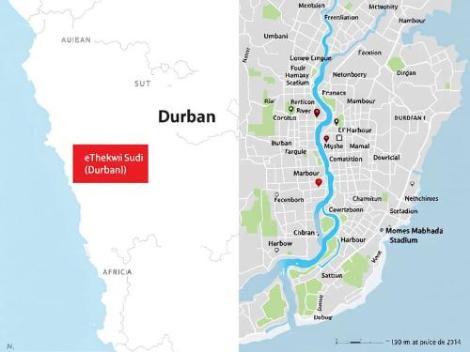
The eThekwini Metropolitan Municipality, situated on the east coast of South Africa, is the country’s third-largest city, with a population of 4.24 million (2022). Its steep, flood-prone coastal terrain is exposed to increasing hydrological risks, including drought and storm damage. During the 2014–2016 drought, flow restrictors were installed on more than half a million water connections to manage demand. In 2022, severe flooding damaged roads and wastewater treatment infrastructure, causing sewage discharges into the Umbilo River and the prolonged closure of beaches due to dangerous levels of E. coli. These repeated crises, combined with rapid urbanisation and the expansion of informal settlements, prompted eThekwini’s water and sanitation department to explore more resilient and decentralised approaches to wastewater management.
The DEWATS (Decentralised Wastewater Treatment Systems) programme was developed to address these challenges by deploying modular, gravity-fed, decentralised wastewater treatment plants in Durban’s informal settlements. This system, developed in partnership with BORDA (Bremen Overseas Research & Development Association) and the University of KwaZulu-Natal (UKZN), aims to enhance water resilience, protect public health and watercourses, whilst recovering water, energy and nutrients for sustainable management. The Newlands-Mashu pilot site, operational since 2014, treats up to 41,000 litres of domestic wastewater per day for 84 households (750 users).
Solutions implemented
-
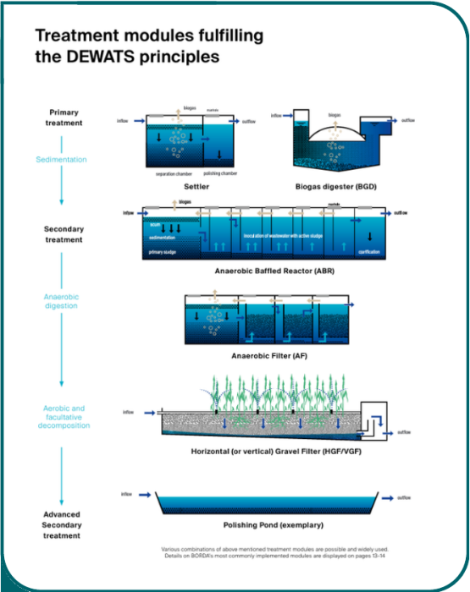
Modular DEWATS system : Comprises a two-chamber settling tank, three parallel baffled anaerobic reactors, two anaerobic filters and a hybrid wetland system (vertical flow to remove ammonia and horizontal flow to refine treatment).
-
Gravity-fed operation : No electricity is required, ensuring continuity of service even in the event of a power cut – a major advantage in areas prone to frequent power cuts.
-
Biogas capture : The methane-rich biogas produced during anaerobic digestion is captured and used for cooking or heating, thereby creating a local source of renewable energy.
-
Reuse of effluent : Treated wastewater is used in automated drip irrigation systems for food crops such as bananas and taro, thereby reducing the demand for fresh water and commercial fertilisers.
-
Sludge composting : Scum and sludge are composted in drying beds, producing nutrient-rich compost that is reused in local agriculture and landscaping.
Key findings
-
Wastewater treatment and recycling : up to 41,000 litres of domestic wastewater are treated daily and reused for non-potable purposes, such as agricultural irrigation.
-
Improved water quality and environmental health : compared with untreated effluent, the water discharged by the DEWATS contains 85 per cent fewer organic pollutants and 75 per cent fewer suspended solids, thereby reducing the risk of eutrophication and improving aquatic biodiversity in adjacent watercourses, such as the Umgeni River.
-
Improvement in public health : the reduction in discharges of raw sewage during floods has led to a reduction in the number of cases of E. coli contamination. Long-term monitoring of the Newlands-Mashu DEWATS demonstration site shows a 98.4 per cent reduction in the presence of E. coli between raw effluent and treated effluent.
-
Food security : the use of treated wastewater for irrigation boosts agricultural productivity, thereby contributing to the community’s food security.
-
Enhancing water resilience : at other sites, DEWATS improve water resilience during droughts and crises by enabling the reuse of treated wastewater for non-potable purposes, such as flushing toilets, thereby ensuring a reliable and safe water supply for essential needs.
Climate and environmental impacts
-
Climate change mitigation : DEWATS systems capture methane from wastewater for cooking or heating, thereby reducing dependence on fossil fuels. They operate without electricity, which reduces demand on the electricity grid and lowers greenhouse gas (GHG) emissions. Compared with conventional centralised wastewater treatment plants, DEWATS generate significantly fewer GHG emissions thanks to their low energy consumption and simpler biological treatment processes.
-
Climate adaptation and resilience : DEWATS operate entirely by gravity, without pumps or an external power supply, ensuring uninterrupted treatment in the event of power cuts, flooding or other disruptions.
Their decentralised design allows wastewater to be treated locally, thereby reducing pressure on centralised infrastructure and preventing sewer overflows during extreme weather events, such as floods.
-
Biodiversity : The Newlands-Mashu DEWATS system removes 95 per cent of organic pollutants and 75 per cent of suspended solids from wastewater, thereby reducing the nutrient and sediment loads discharged into neighbouring watercourses, such as the Umgeni River. This creates healthier ecosystems and increases the diversity of aquatic, animal and plant species.
Success factors
-
Values :
- Recognising domestic wastewater as a source of water, energy and nutrients, rather than simply as waste to be disposed of.
- Awareness of the benefits of decentralised, human-scale systems for building climate resilience and reducing vulnerability to disruptions.
-
Connections :
- Physical connections : DEWATS offer a modular, off-grid solution integrating wastewater treatment, reuse and resource recovery.
- Social connections : The success of the initiative relies on knowledge-sharing and active community participation :
Training and collaboration with local residents enable community-led management and maintenance of the system, fostering a sense of ownership.
Regular communication through workshops and educational materials helps to promote a culture of wastewater reuse and resource recovery.
A global network of researchers and practitioners, coordinated by BORDA, supports the implementation of DEWATS through forums, academic publications and technical exchanges.
-
Investment : Low investment and operating costs, combined with community-managed operation and maintenance, create a viable economic model that can be replicated on a large scale.
Scalability for Morocco
The DEWATS model has proven its viability worldwide, with over 2,700 systems deployed across diverse geographical and climatic zones. This decentralised, modular and energy-efficient system ensures reliable wastewater treatment without the need for an external power supply or chemicals, making it suitable for informal and underserved urban areas. In Morocco, where many municipalities face the challenges of rapid urbanisation and water scarcity, adapting the DEWATS model could enhance water supply security and resilience to climate change.
Cities such as Agadir and Rabat, which are experiencing rapid peri-urban growth and are actively pursuing initiatives to improve informal settlements and expand sanitation provision, could benefit from modular, decentralised wastewater treatment systems in underserved communities. By incorporating these systems into planning and building regulations, training community operators and mobilising blended finance, Moroccan cities can adapt this proven model to close water and nutrient cycles, protect public health and strengthen local capacity for circular and sustainable wastewater management.
Referencias
Online document, see pages 27 to 40 : Gestion circulaire et résiliente de l’eau en milieu urbain - Circular and resilient water management in urban areas
Para ir más allá
Websites: iclei.org/ & iclei-europe.org/
Bibliography:
1. Arumugam, P., Zuma, L., Mercer, S., Govender, L., Pocock, J., Brouckaert, C. J., & Gounden, T. (2023). The potential of decentralised wastewater treatment in urban and rural sanitation in South Africa: Lessons learnt from a demonstration-scale DEWATS within the eThekwini Municipality. (Le potentiel du traitement décentralisé des eaux usées dans l’assainissement urbain et rural en Afrique du Sud : leçons tirées d’un projet pilote DEWATS à l’échelle de la municipalité d’eThekwini). Water SA, 49(1). doi.org/10.17159/wsa/2023.v49.i1.3985
2. Bremen Overseas Research & Development Association (BORDA). (2017). DEWATS Inventory 2017: Statistics on decentralized wastewater treatment systems implementation 1989–2017 (Inventaire DEWATS 2017 : statistiques sur la mise en œuvre des systèmes décentralisés de traitement des eaux usées 1989-2017). borda.org/wp-content/uploads/2023/06/DEWATS_Inventory_2017_web.pdf
3. Bremen Overseas Research & Development Association (BORDA). (2017). Decentralized wastewater management & communal sanitation: A quick and effective tool to provide sustainable sanitation (Gestion décentralisée des eaux usées et assainissement communal : un outil rapide et efficace pour fournir un assainissement durable). www.susana.org/_resources/documents/default/3-3154-7-1523881373.pdf
4. Bremen Overseas Research & Development Association (BORDA). (2018). Rapport annuel 2017-2018. borda.org/wp-content/uploads/2023/11/2018-EN.pdf
5. Buell, S. (30 janvier 2025). Decentralized wastewater treatment: A municipal guide for 2024 (Traitement décentralisé des eaux usées : guide municipal pour 2024). O&M Solutions.www.oandmsolutions.com/blog/decentralized-wastewater-treatment-a-municipal-guide-for-2024
6. Consortium for DEWATS Dissemination (CDD) Society. (s.d.). DEWATS Guidebook: A practical guide for the design and implementation of decentralized wastewater treatment systems. Sustainable Sanitation and Water Management (SSWM) Toolbox. (Guide DEWATS : guide pratique pour la conception et la mise en œuvre de systèmes décentralisés de traitement des eaux usées. Boîte à outils pour l’assainissement durable et la gestion de l’eau (SSWM)). sswm.info/sites/default/files/reference_attachments/DEWATS_Guidebook_small.pdf.
7. Ministère de l’Eau et de l’Assainissement. (2017). Politique nationale d’assainissement 2016 (politique n°17005SC).www.dws.gov.za/Documents/sanitation/17005SC_POLICY_National Sanitation Policy 2016 FINAL310117.pdf
8. Municipalité d’eThekwini. (2023). Plan de développement intégré 2023-2024 à 2027-2028. www.durban.gov.za/storage/Documents/Integrated Development Plans IDP - eThekwini Municipality/Integrated Development Plan 2023-24 to 2027-28.pdf.
9. Municipalité d’eThekwini. (9 juillet 2024). Bulletin hebdomadaire d’eThekwini (numéro 387). www.durban.gov.za/storage/Documents/Weekly Bulletins/Year 2024/EThekwini_Weekly Bulletin (Issue 387).pdf.
10. Banque islamique de développement (BID). (2021). SANIMAS model as an approach for providing decentralised sanitation. (Le modèle SANIMAS comme approche pour fournir des services d’assainissementdécentralisés.) www.isdb.org/sites/default/files/media/documents/2021-03/SANIMAS Model_as an Approach for Prodiving Decentralised Sanitation_March 2021.pdf.
11. Kelly, K. (janvier/février 2022). Decentralised plants: DEWATS is an approach rather than a technical hardware package (Installations décentralisées : DEWATS est une approche plutôt qu’un ensemble de matériel technique). Water Sanitation Africa, 25-26. borda.org/wp-content/uploads/2023/08/WASA-Jan-2022-BORDA73.pdf
12. Le Desk. (27 mai 2025). « Villes sans bidonvilles » : la moyenne annuelle des ménages bénéficiaires passe à 18 500. Le Desk. ledesk.ma/encontinu/villes-sans-bidonvilles-la-moyenne-annuelle-des-menages-beneficiaires-passe-a-18-500/.
13. Musazura, W., Odindo, A. O., Tesfamariam, E. H., Hughes, J. C., & Buckley, C. A. (2018). Decentralised wastewater treatment effluent fertigation: Preliminary technical assessment (Ferti-irrigation décentralisée des effluents issus du traitement des eaux usées : évaluation technique préliminaire). Water SA, 44(2), 250–257. doi.org/10.4314/wsa.v44i2.10
14. Odindo, A. O., Musazura, W., Onyango, B., Nkomo, N., Oluochi, B., Khumalo, S., Nxumalo, S., & Ojwach, S. (2024). Transformative approaches in managing human waste and wastewater by reframing nutrient recovery from innovative sanitation technologies as integral components of farming and food systems (Approches transformatrices dans la gestion des déchets humains et des eaux usées en recadrant la récupération des nutriments à partir de technologies sanitaires innovantes comme composantes intégrales des systèmes agricoles et alimentaires) (rapport WRC n° 3151/1/24). Water Research Commission. www.wrc.org.za/wp-content/uploads/mdocs/3151 final.pdf.
15. One Pulse Africa. (27 septembre 2024). Historic signing of tripartite agreement by eThekwini Municipality, Namibia, and Germany. (Signature historique d’un accord tripartite entre la municipalité d’eThekwini, la Namibie et l’Allemagne). One Pulse Africa. onepulseafrica.co.za/2024/09/27/historic-signing-of-tripartite-agreement-by-ethekwini-municipality-namibia-and-germany/.
16. Pollution Research Group & Bremen Overseas Research & Development Association. (2014). Projet DEWATS – Newlands-Mashu. Université du KwaZulu-Natal. washcentre.ukzn.ac.za/dewats-projects/.
17. Pollution Research Group & Bremen Overseas Research & Development Association (Groupe de recherche sur la pollution et Association de recherche et développement outre-mer de Brême) (2014). DEWATS process for decentralised wastewater treatment: Technical lessons from eThekwini Municipality. University of KwaZulu-Natal (Processus DEWATS pour le traitement décentralisé des eaux usées : enseignements techniques tirés de la municipalité d’eThekwini). Université du KwaZulu-Natal. washcentre.ukzn.ac.za/wp-content/uploads/2020/11/BORDA-project-dewats-process-lessons-from-ethekwini.pdf.
18. Seetal, A., Mathye, M., Mahlangu, W., & Godfrey, L. (2023). Enabling South Africa’s water security through a circular economy (Assurer la sécurité hydrique de l’Afrique du Sud grâce à une économie circulaire) (rapport CSIR n° CSIR/SPLA/WC/ER/2023/0028/C). Council for Scientific and Industrial Research (Conseil pour la recherche scientifique et industrielle) (CSIR). www.circulareconomy.co.za/wp-content/uploads/2023/08/Water_Report-CE-Opportunities.pdf.
19. Tamni, F. (2025, 14 juillet). « Villes sans bidonvilles » : des familles casablancaises victimes de lenteurs administratives. TelQuel. telquel.ma/instant-t/2025/07/14/villes-sans-bidonvilles-des-familles-casablancaises-victimes-de-lenteurs-administratives_1942312/.
20. Tesfamariam, E. (2018). A map of the Newlands-Mashu experimental site showing the decentralised wastewater treatment plant (DEWATS), the experimental field and the nearby river. (Carte du site expérimental de Newlands-Mashu montrant la station d’épuration décentralisée (DEWATS), le champ expérimental et la rivière voisine). Dans W. Musazura, A. O. Odindo, E. Tesfamariam et C. A. Buckley (dir.), Decentralised wastewater treatment effluent fertigation: Preliminary technical assessment (Ferti-irrigation des effluents issus du traitement décentralisé des eaux usées : évaluation technique préliminaire). ResearchGate. www.researchgate.net/figure/A-map-of-the-Newlands-Mashu-experimental-site-showing-the-decentralised-wastewater_fig1_324924960.
21. WASH R&D Centre. (n.d.). Bailleurs de fonds et partenaires. Université du KwaZulu-Natal. washcentre.ukzn.ac.za/funders-partners/.
22. Banque mondiale. (2013). Review of community-managed decentralized wastewater treatment systems in Indonesia. Water and Sanitation Program (Examen des systèmes décentralisés de traitement des eaux usées gérés par la communauté en Indonésie. Programme eau et assainissement). openknowledge.worldbank.org/server/api/core/bitstreams/bab3022f-2ccd-513c-bef5-08f61158b5fe/content.
23. Zhang, L., Li, Y., & Wang, H. (2023). Detection of dental periapical lesions using Retinex-based image enhancement and lightweight deep learning model. (Détection des lésions dentaires périapicales à l’aide d’un modèle d’amélioration d’image basé sur Retinex et d’un modèle d’apprentissage profond léger). Journal of Dental Sciences, 18(1), 123–135. doi.org/10.1016/j.jdsci.2023.02.004.