Use of rainwater in the city of Sumida (Japan)
Circular and resilient water management in urban areas
agosto 2025
ICLEI-Local Governments for Sustainability
To the east of Tokyo, the city of Sumida has successfully turned a challenge into an opportunity by developing an innovative rainwater harvesting network that combines urban resilience with community engagement.
Faced with recurring risks of flooding and water shortages, this initiative, launched in 1982, has made Sumida a global model for decentralised and participatory water management. Through public, private and community infrastructure, the city has reduced its dependence on external sources whilst strengthening its preparedness for natural disasters.
This project illustrates how a local and collaborative approach can address the climate and water challenges facing modern cities.
This factsheet summarises one of the 12 case studies in the document: Circular and Resilient Urban Water Management
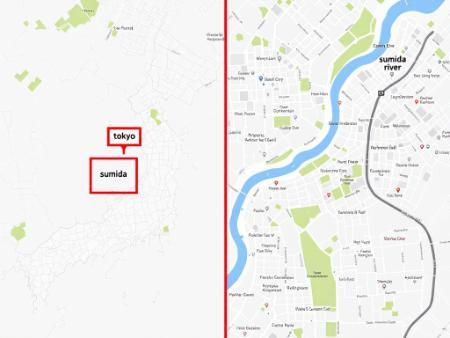
The city of Sumida, situated to the east of Tokyo, faces recurring flood risks due to its low elevation, dense urbanisation and low soil permeability, particularly during typhoons. These floods, such as those of 1981 which caused significant property damage and left residents without drinking water for several weeks, have highlighted the city’s vulnerability. Furthermore, Sumida suffers from water shortages during periods of low rainfall, due to its dependence on upstream dams. With a population of 286,852 (2024) and a humid subtropical climate (1,440 mm of annual rainfall), the city needed to find sustainable solutions to secure its water supply and mitigate the risks associated with extreme weather events.
Launched in 1982, the Sumida City Rainwater Utilisation Initiative aims to strengthen urban resilience through the collection and reuse of rainwater, whilst reducing flood risks and dependence on external sources. This pioneering project, led by Sumida City Council, has made the city a global model for decentralised and participatory water management, involving public, private and community infrastructure.
Solutions implemented
-
Rainwater harvesting systems (RHS) : installed in 49 public buildings (e.g. : Ryogoku Kokugikan Sumo Stadium, City Hall) and over 415 private buildings (e.g. : Tokyo Skytree), with underground tanks for storage.
-
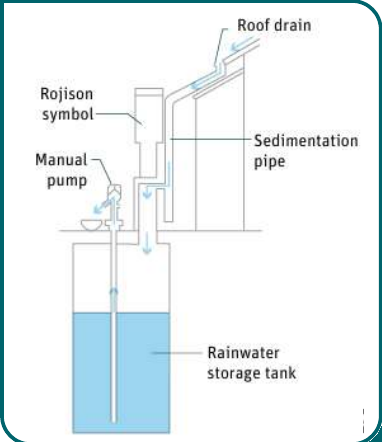
‘Rojison’ community facilities: 20 simple systems with hand pumps, used for daily needs, firefighting and the supply of drinking water in emergencies.
-
Permeable pavements: promote groundwater recharge.
-
Green roofs : improve biodiversity and reduce the urban heat island effect.
Key results
-
A 15% reduction in peak stormwater flow, limiting the risk of flooding.
-
Over 10,000 m³ of rainwater collected and reused annually, reducing supply costs.
-
Improved disaster preparedness thanks to ‘ Rojison ’ installations.
-
Enhanced biodiversity : Return of rare species to green roofs.
Climate and environmental impacts
-
Climate change mitigation : Local rainwater harvesting systems have reduced the carbon footprint associated with water supply by eliminating the need to transport water over long distances, an energy-intensive operation. By collecting 10,000 m³ of rainwater per year, Sumida reduces its CO₂ emissions by 2.6 tonnes annually.
-
Climate adaptation and resilience : Stormwater management systems, green roofs and permeable pavements have strengthened the city’s capacity to manage rainwater, thereby preventing urban flooding. These systems also ensure access to non-potable water in the event of a disaster or drought, whilst helping to mitigate the urban heat island effect.
-
Biodiversity : Green roofs have enriched local biodiversity, even encouraging the return of rare species to an otherwise highly mineralised urban environment.
-
Other environmental benefits : Improved groundwater recharge thanks to permeable surfaces, and reduced surface runoff, which lowers pollutant concentrations in local water bodies.
Success factors
-
Values : Recognition of water as a precious resource to be collected and reused, with an approach emphasising decentralisation and community ownership of rainwater harvesting facilities. Educational programmes have raised residents’ awareness of the importance of this practice.
-
Connections :
- physical connections : local water collection, storage and distribution networks have created a coherent infrastructure system that supports rainwater harvesting throughout the city.
- social connections : the success of the initiative rests on knowledge-sharing and the forging of community ties, notably through the empowerment of local communities in the management and maintenance of rainwater harvesting systems, as well as collaboration between different sectors (public authorities, NGOs, the private sector).
-
Investment : Rainwater harvesting systems are cost-effective and generate sufficient savings to make them financially viable. Municipal grants cover up to 50 per cent of the costs for private individuals, with a return on investment in under 10 years thanks to savings on water bills.
Replicability for Morocco
The Sumida initiative offers a model that can be adapted to Moroccan cities facing irregular rainfall and increasing water stress, such as Agadir, Rabat and Tangier. The installation of SCEP systems in public and private buildings, combined with permeable surfaces and community-managed storage facilities, could improve water security and climate resilience in these cities. These measures are in line with Morocco’s national strategies for sustainable water management and can be adapted to local contexts, thereby providing a practical and proven framework for tackling water scarcity and urban flooding.
Referencias
Online document; see pages 15 to 26: Gestion circulaire et résiliente de l’eau en milieu urbain - Circular and Resilient Urban Water Management
Para ir más allá
Websites : iclei.org/ & iclei-europe.org/
Bibliography
1. Aleksejeva, J., Vulgaris, G, & Gasparatos, A. (2022). Assessing the potential of strategic green roof implementation for green infrastructure: Insights from Sumida ward [Évaluation du potentiel de la mise en œuvre stratégique de toitures végétalisées pour les infrastructures vertes : aperçu du quartier de Sumida], à Tokyo. Urban Forestry & Urban Greening, Volume 74, août 2022, doi.org/10.1016/j.ufug.2022.127632.
2. Bureau of Waterworks, Tokyo Metropolitan Government (2023). CO2 Calculator.www.waterworks.metro.tokyo.lg.jp/kurashi/co2.
3.Centre for Science and Environment (Centre pour la science et l’environnement) (n.d.). Rainwater harvesting in Tokyo, Japan [Collecte des eaux de pluie à Tokyo, Japon]. www.rainwaterharvesting.org/international/tokyo.htm.
4. Down To Earth (15 octobre 1998). The value of a raindrop [La valeur d’une goutte de pluie]. www.downtoearth.org.in/environment/the-value-of-a-raindrop-22484.
5. Foreign Press Center Japan (Centre pour la presse étrangère au Japon) (23 août 2013). Visite de presse : Tokyo se prépare à l’éventualité d’un tremblement de terre directement sous la zone métropolitaine de Tokyo. fpcj.jp/en/assistance-en/tours_notice-en/p=6242/.
6. International Council for Local Environmental Initiatives (ICLEI) (1997). Success Stories from Asia and the Pacific: Rainwater Storage and Utilization. Earth Summit +5: Special Session of the General Assembly to Review and Appraise the Implementation of Agenda 21. [Réussites en Asie et dans le Pacifique : stockage et utilisation des eaux de pluie. Sommet de la Terre +5 : session extraordinaire de l’Assemblée générale consacrée à l’examen et à l’évaluation de la mise en œuvre du Programme 21] www.un.org/esa/earthsummit/w-sumida.htm.
7. Iwata, T. & Shimoda, R. (2024). Spontaneous vegetation in mandatory green roofs at public educational facilities in Sumida-ku [Végétation spontanée sur les toitures vertes obligatoires des établissements d’enseignement publics de Sumida-ku], Tokyo. Landscape Research Japan Online ,17:38-46, mai 2024. doi.org/10.5632/jilaonline.17.38.
8. Japan for Sustainability (février 2003). Promoting Rainwater Utilization Promouvoir l’utilisation de l’eau de pluie [ Bulletin d’information JFS n° 6]. www.japanfs.org/en/news/archives/news_id027756.html.
9.Japan Meteorological Agency (Agence météorologique japonaise) (2025). Total mensuel des précipitations (mm). www.data.jma.go.jp/stats/etrn/view/monthly_s3_en.php.
10.Ministère japonais de l’Environnement (2000). Promotion of rainwater utilization in Sumida Ward [Promotion de l’utilisation de l’eau de pluie dans l’arrondissement de Sumida]. Dans G8 Environmental Futures Forum , Domestic Best Practices Addressing Climate Change [Forum sur l’avenir environnemental, Meilleures pratiques nationales en matière de lutte contre le changement climatique] (Japon n° 12). www.env.go.jp/earth/g8_2000/forum/g8bp/detail/japan/japan12.html.
11. Nafisah, A. & Matsushita, J. (2009). Comparative Study on rainwater harvesting practice between two metropolises: (Étude comparative sur les pratiques de collecte des eaux de pluie entre deux métropoles ): Tokyo (Sumida-Ku) et Selangor, Malaisie. Shibaura Institute of Technology (Institut de technologie de Shibaura), 14th International Rainwater Catchment Systems Conferences (14e Conférence internationale sur les systèmes de collecte des eaux de pluie). ssms.jp/img/files/2019/04/sms10_117.pdf.
12. Quadros, C. S. (2010). Rainwater Harvesting Case Study: FCT/UNL Campus. <(Étude de cas sur la collecte des eaux de pluie : Campus FCT/UNL.] (Mémoire de master). Université Nova de Lisbonne. run.unl.pt/handle/10362/4799.
13. Samadar, S. & Okada, N. (2007). The process of community’s coping capacity development in the Sumida Ward, Tokyo: A case of rainfall harvesting movement. [Le processus de développement de la capacité d’adaptation de la communauté dans le quartier de Sumida, à Tokyo : le cas du mouvement de collecte des eaux de pluie]. Annales de l’Institut de recherche sur la prévention des catastrophes, Université de Kyoto, n°50B. www.dpri.kyoto-u.ac.jp/nenpo/no50/ronbunB/a50b0p21.pdf.
14. Strauss, G. (13 novembre 2016). Reining in the rain [Maîtriser la pluie] National Geographic. www.nationalgeographic.com/science/article/makoto-murase-explorer-moments-rain-water-
conservation-Japan.
15.Ville de Sumida (2005). Sumida Basic Environmental Ordinance. [Ordonnance fondamentale sur l’environnement de Sumida.]www.city.sumida.lg.jp/reiki_int/reiki_honbun/g108RG00001286.html.
16. Ville de Sumida (2024). History of Rainwater Utilization. [Histoire de l’utilisation de l’eau de pluie]. www.city.sumida.lg.jp/kurashi/kankyou_hozen/amamizu/riyou/amamizu_rekisi.html.
17. Ville de Sumida (2024). The Second Co-creation Plan for Sumida Environment [Deuxième plan de co-création pour l’environnement de Sumida] (révision provisoire). www.city.sumida.lg.jp/kurashi/kankyou_hozen/keikaku/keikaku_kankyou/kyousoukaitei.html? SLANG=ja&TLANG=en&XMODE=0&XCHARSET=utf-8&XJSID=0.
18. Sumida City Environmental Policy Division (Division de la politique environnementale de la ville de Sumida) (2024). Sumida Rainwater Utilization Guide. (Guide d’utilisation des eaux pluviales de Sumida.) www.city.sumida.lg.jp/kurashi/kankyou_hozen/amamizu/whats_amamizu/index.files/amamizu2.pdf.
19. Sumida City Planning and Economic Office (Bureau de l’urbanisme et de l’économie de la ville de Sumida) (1995). Sumida Ward Rainwater Utilization Promotion Guidelines. [Directives pour la promotion de l’utilisation de l’eau de pluie dans l’arrondissement de Sumida.] www.city.sumida.lg.jp/reiki_int/reiki_honbun/g108RG00000814.html.
20. The Asahi Shimbun (novembre 2020). Sato Project: Sowing seeds of rainwater harvesting globally. [Projet Sato : semer les graines de la collecte des eaux de pluie à l’échelle mondiale.] The Asahi Shimbun. www.rolex.org/partnerships/asahi/makoto-murase.
21. Banque mondiale (2019). Learning from Japan’s Experience in Integrated Urban Flood Risk Management: A Series of Knowledge Notes—Appendix: Case Studies in Integrated Urban Flood Risk Management in Japan. [Tirer les leçons de l’expérience japonaise en matière de gestion intégrée des risques d’inondation urbaine : une série de notes d’information — Annexe : études de cas sur la gestion intégrée des risques d’inondation urbaine au Japon.] Banque mondiale, Washington, D.C. documents1.worldbank.org/curated/en/915131601460271575/pdf/Appendix-Case-Studies-in-Integrated-Urban-Flood-Risk-Management-in-Japan.pdf.
22. Yamada, T. (2014). Rain Water Harvesting and Subject of Sustainable Community Building for Disaster Mitigation: The Process of ‘Rojison’ Rain Water Harvesting System Building And Subject of Sustainable Management for It. Kyoto Graduate School of Global Environmental Studies. [La collecte des eaux de pluie et la question de la construction de communautés durables pour l’atténuation des catastrophes : le processus de mise en place du système de collecte des eaux de pluie « Rojison » et la question de sa gestion durable. École supérieure d’études environnementales mondiales de Kyoto]. www2.ges.kyoto-u.ac.jp/wp-content/uploads/2014/04/427.pdf.
23. Zhang, L. & Li, X. (2022). Assessing the potential of strategic green roof implementation for urban sustainability. [Évaluation du potentiel de la mise en œuvre stratégique de toitures végétalisées pour la durabilité urbaine.], Urban Forestry & Urban Greening, volume 70. doi.org/10.1016/j.ufug.2022.127460.