Cities100: Delhi is providing clean and free water for all and investing in a water-secure future
C40 Cities Climate Leadership Group, Nordic Sustainability, October 2019
Delhi made a pledge to provide access to clean drinking water to all its citizens at an affordable price, and as a human right.
The equity-driven plan offers up to 20 Kl of water a month to households with metered connections, and sizeable future investment in improving water security for Delhi’s residents.
The improvements include expansion of water distribution infrastructure, wastewater treatment, and restoring water bodies to recharge and store groundwater.
Delhi’s pledge of “Jal Swaraj” (Self Governance of Water) comes amidst India’s challenge of water insecurity, with many residents forced to buy water from private tankers operated by the water mafia. About 30% of Delhi’s population lives in informal settlements, which are historically lacking in access to water and sanitation infrastructure.
The city is addressing this challenge with an urgent plan of action aiming to connect all residents of Delhi with water and sewage services, regardless of their legal status. Citizens are offered an 80% rebate for the installation of pipelines, contributing to the goal of citywide coverage within five years, which will provide connections to 1.4 million households currently without a piped water supply. A network of small but efficient decentralised sewage treatment plants have been developed, primarily near informal settlements, and the city is treating wastewater and prevent the discharge of pollution into 281 water bodies.
This is one of the 100 solutions highlighted in the 2019 edition of Cities100. Now in its fourth year, Cities100 provides recognition for 100 of the boldest projects from cities around the world which are working to address climate change and build a better, greener future. The publication highlights solutions that are replicable and scalable, and which reduce emissions and address the issues that cities face as a result of climate change. Read the Cities100 report, by C40 and Nordic Sustainability, for full details.
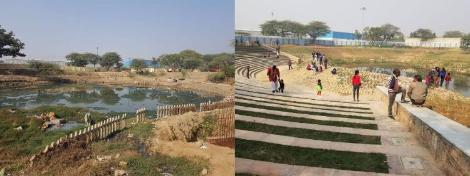
To address water security and recharge Delhi’s low water table, the city is promoting citizen-based water management including water conservation, recycling, and rainwater harvesting. The Yamuna River will also be restored by preventing inflow of pollutants, re-naturalisation, and ponds are being restored and created to store floodwaters for later use - the before and after photographs below show one example.
Delhi’s advice for other cities
De l’eau pour tous, pas seulement pour certains
Les citoyens défavorisés sur le plan économique sont particulièrement exposés à l’insécurité hydrique. La distribution gratuite d’eau, la réduction de 80 % des frais de raccordement au réseau d’eau et d’assainissement, ainsi que la réduction des frais de développement du réseau de canalisations contribuent à corriger les inégalités et à améliorer systématiquement la sécurité hydrique à Delhi pour tous les citoyens.
Tirer le meilleur parti des eaux grises
Delhi s’efforce de tirer le meilleur parti de l’eau recyclée afin de soulager la pression sur les réserves d’eau potable. La ville a mis en place des stations d’épuration décentralisées dans les quartiers résidentiels afin d’éviter la contamination des plans d’eau par les eaux usées et de fournir de l’eau traitée à des fins non potables, telles que les toilettes et le jardinage. Des systèmes à double circuit d’alimentation en eau seront déployés dans les lotissements, ce qui permettra d’optimiser l’utilisation de l’eau recyclée.
Wider benefits
Social: The government of Delhi is making water distribution systems more transparent, efficient, and accessible by expanding infrastructure to reach communities, including those that are unauthorised. By providing equitable access to water, the city is ousting the water mafia and creating happier neighbourhoods.
Health: To beat the extreme heat, citizens will be provided with clean drinking water free of charge via hundreds of water dispensers installed in public places. Improved access to sanitation will also bolster citizens’ health, so the city has built 100,000 restrooms, mostly in unauthorised colonies.
Economic: By regulating private tankers, citizens will be protected from exorbitant prices. Changes in water tariff regulations will relieve small shop owners from paying commercial water prices, aiding local businesses.
Environmental: Delhi comprises just 2% of the catchment area of the Yamuna River, but is the source of 80% of the pollution flowing into it. An investment of $54 million has been made towards a comprehensive action plan to intercept and treat sewage.
Sources
Online document: Cities100: Delhi is providing clean and free water for all and investing in a water-secure future
To go further
Website: www.c40.org/