CITIES100: 100 city projects making the case for climate action
2019
The Cities100 (2019) report highlights 100 global climate projects led by cities, showcasing their co-benefits for safe, livable, and equitable urban spaces. It includes city-specific advice and emphasizes that no single solution fits all, aiming to inspire similar action.
The report analyzes local challenges and technologies used. It underscores how these initiatives tackle beyond greenhouse gas emissions, with diverse structures and success factors.
Explore the data via interactive visualizations on the Cities100 website.
Para descargar: cities100_2019_report_en.pdf (42 MiB)
How frontrunner cities are tackling the climate crisis
Cities100 (2019) highlights 100 of the most innovative projects from cities across the globe that are taking a lead in tackling the climate crisis. In this year’s report, we have collated and analysed data from each project in order to provide insights into how front- runner cities are finding innovative approaches to dealing with the most urgent social and environmental issues of our time. The objective of this in-depth analysis is to offer a new perspective that can be of use to cities with similar challenges across the planet. While we recognise there is no one-size-fits-all approach to successfully develop or implement climate action projects, this analysis points to several central insights that are applicable for many hundreds of cities around the world.
Four insights from 100 climate cases
Insight one: Cities deliver significant co2e reductions
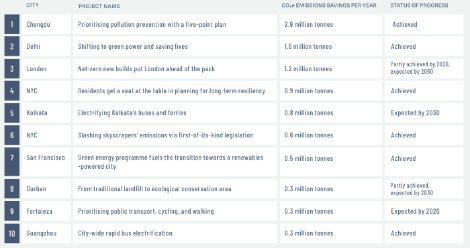
As climate change climbs up the local government agenda, an ever-growing number of exciting climate action projects are being initiated. However, with a need to halve global carbon emissions by 2030 to limit warming to 1.5°C1, achieving significant results from city climate action has never been more urgent. Fortunately, there is much to learn from the approach taken by cities in the publication to cutting emissions. The results speak for themselves, with the top 10 emissions reductions projects in this year’s report totalling 9.3 million tonnes of CO2e emissions avoided every year – equivalent to the annual emissions of Panama. Due to the wide variety of projects highlighted in the report, some of these savings – such as Chengdu, which managed to reduce its annual CO2e emissions by 2.9 million tonnes between 2013 and 2017 – have already been achieved, while other projects expect the full potential of the savings to be realised in the coming years.
Top 10 CO2e emissions reductions projects from Cities100 2019
Insight two: Climate action projects address more than just co2e
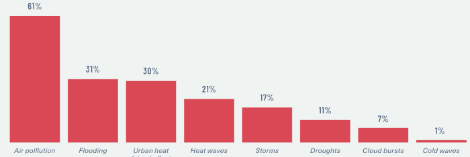
While the importance of curbing carbon emissions must not be underestimated, it is worth highlighting that 61% of the 100 projects are addressing air pollution. Given that outdoor air pollution from fossil fuel combustion causes an estimated 3.6 million deaths globally each year2, improving urban air quality will result in significant, tangible benefits to public health and citizens’ lives. The two other most prominent local climate change challenges being addressed were flooding and the urban heat island effect with 31% and 30% of projects targeting each issue, respectively.
Local climate change challenges adressed by projects
Insight three: Mayoral leadership is a key factor for project success
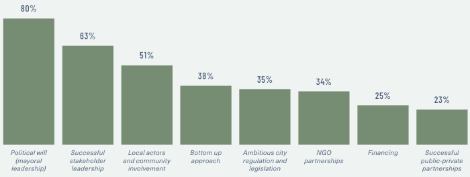
While waiting for national governments to set ambitious targets and goals for the climate, mayors and local city officials are moving forward with projects targeting both environmental and social issues. 80% of the projects in this report identified this kind of strong political will as crucial to achieving successful outcomes. Successful stakeholder leadership was considered key for 63% of projects, while just over half (51%) of projects deemed local community involvement to be instrumental in realising climate action projects.
Success factors in the implementation of projects
Insight four: New technologies are not always critical for climate action
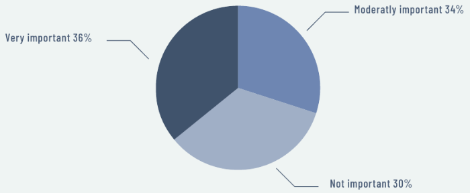
Although new technologies were considered “very important” and “moderately important” in 36% and 34% of cases, respectively, it is worth noting that almost a third (30%) of projects did not consider new technologies to be of any importance to their project’s success. Even though technological advances can be important in certain sectors, such as clean energy and low-carbon transport, a lack of access to the latest technology is not a barrier to taking effective climate action. Many of the projects featured in Cities100 utilise natural climate solutions, engage citizens in local climate projects, or enhance cityscapes to encourage active transport, ultimately taking substantial climate action without turning to the newest technological fixes.
Importance of new technology in the development of projects
Cities100 case studies
The cities and initiatives included in Cities100 2019 cover 12 topics, listed below.
Adaptation and resilience
As the climate crisis brings rising sea levels, more floods, and greater drought and heat, people and properties in cities are on the frontline. Fortunately, adaptation projects are boosting cities resilience to these events, and cities are increasingly implementing low-tech, nature-based solutions.
Air quality
Over half of the solutions across Cities100 also address air pollution, especially those from cities in South and West Asia (86%), Latin America (82%), and Central East Asia (67%), which suffer some of the worst air pollution in the world. Air pollution and climate change go hand in hand – read Win-Win: Why cities should tackle climate change and air pollution together to find out more.
By introducing emissions standards in city centres, car-free days, efficient public transportation, and initiatives to reduce idling, these cities are directly targeting improved air quality for the benefit of their citizens’ health.
Building energy efficiency
Powering, heating, and cooling buildings can account for up to 70% of a city’s energy consumption, so increasing energy efficiency can yield significant cuts to both costs and carbon emissions. As cities introduce more ambitious building energy standards, the number of zero-carbon buildings, as well as deep retrofits to old buildings, is skyrocketing.
Citizen engagement
Cities are increasingly integrating meaningful citizen engagement, and experimenting with creative ways to involve citizens in campaigns, projects, and planning processes. Not only can citizen participation contribute to the overall success of a project, it can amplify the project’s impact, and trigger cultural and behavioural change.
Clean energy
With energy use accounting for around 70% of global greenhouse gas emissions, accelerating the shift towards a low-carbon energy system is crucial. Fortunately, cities are already boosting demand in renewables by making it easier for citizens and businesses to buy low-cost, low-carbon power.
Climate action planning
Through comprehensive, evidence-based climate action planning, cities are laying the groundwork to decrease their contribution to climate change and protect their citizens from future impacts.
Inclusive climate action
Around the world, inclusivity is increasingly recognised as a prerequisite for climate action. As the impacts of the climate crisis disproportionately affect low-income and marginalised communities, cities are including representatives from these communities in project development to ensure that city projects are socially just, and that no one is left behind.
Sustainable finance
Financial instruments and divestment projects are increasingly being utilised to help accelerate the decarbonisation of the global economy. Unleashing the power of international markets, via green bonds for example, is enabling rapid build-out of green energy capacity.
Sustainable food systems
With climate change expected to have significant, but uncertain, impacts on the global food system, leading cities are making concerted efforts to reduce food waste. By boosting food waste collection and incentivising surplus food donations, cities are ensuring their least well-off citizens have better access to food, while building more circular, resourceful economies.
Sustainable mobility
The sustainable mobility case studies highlight how cities are putting people before traffic. Prioritising public transport, cycling, and walking, and redesigning cities to be bicycle- and people-centric are some of the steps cities are taking towards a low-carbon future.
Sustainable waste management
From cities that are reducing waste via online tools or recycling, to transforming landfills into conservation sites and inventing ways to turn waste products into resources, cities are re-imagining waste into valuable resources.
Water management
Increasing extreme weather events and growing populations are challenging cities faced with droughts and floods, and pressuring local water supplies. Cities are taking preventative approaches to enable a future with clean water to drink, and neighbourhoods safe from flooding.
Download the report to find all the Cities100 case studies.
1 The findings of the IPCC’s Special Report on 1.5°C suggest that to limit warming this century to 1.5°C, global carbon emissions need to be cut in half by 2030.
2 Lelieveld, J., et al., 2019. Effects of fossil fuel and total anthropogenic emission removal on public health and climate. Proceedings of the National Academy of Sciences, 116(15), pp.7192-7197
Referencias
Online document: CITIES100: 100 city projects making the case for climate action
Para ir más allá
-
Cities100 is a collaboration between C40 Cities,Nordic Sustainability, and Realdania.
-
Visit the Cities100 website to explore the data in interactive visualisations, or find current leading examples inAmbitious, successful and replicable: City climate actions you should know about.