Beyond Recycling: Unlocking the Potential of Second-Life Batteries for Urban Communities
Javier Leiva, 2026
European Urban Initiative (EUI)
As the demand for energy storage soars—driven by electrification and renewables—second-life batteries emerge as a circular solution to two urgent urban challenges: energy poverty and grid congestion. While new battery prices plummet, retired EV batteries still hold 70–80% of their capacity, offering a cost-effective, sustainable alternative for applications like neighborhood energy systems or construction sites.
The BatteREstore project tackles the key barriers—lack of data, supply chain gaps, and economic viability—by repurposing batteries without physical modification, leveraging original designs and software insights. By turning retired batteries into reliable storage, it reduces waste, lowers energy costs, and eases grid pressure, proving that circularity can be both environmentally sound and economically smart.
Why second-life batteries matter now? Energy storage applications have seen extraordinary growth in recent years. From widely used solutions in consumer electronics, like phones and other mobile devices, to larger-scale deployments in transport and as support for grids and renewable energies.
This rising demand for energy storage is translating into strong pressure on the raw materials that make it possible. This highlights the importance not only of recycling methods, to maximize the use of all recoverable material, but even more so of circularity in the entire process, allowing for a reuse phase before final recycling.
BatteREstore takes on this challenge to address, first, the fight against energy poverty by making energy more affordable and accessible to underserved communities. And, second, it addresses the constraints that grid congestion poses in cities—an issue that can even prevent new housing developments or the integration of renewables, such as in cities like Tilburg, where grid limitations may represent a critical bottleneck, lacking capacity to meet energy demand or handle certain generation surpluses.
The real challenge in practice
Battery prices for new production keep dropping. According to the International Energy Agency, lithium-ion battery pack prices fell by 20% in 2024—the largest annual decline since 2017—driven by lower critical mineral prices and increasing manufacturing competition; at the same time, global battery demand surpassed 1 TWh for the first time, reflecting the rapid expansion of electrification and energy storage markets.
This trend, although positive for the adoption of practical energy storage applications and electrification of demand, may become a major threat from a potential environmental impact perspective and lifecycle analysis. In other words, a cheap new battery may seem more attractive than a second-life battery. But the reality is that electric vehicle (EV) batteries, once retired from transport use, still retain value, and their remaining technical performance makes them equally suitable for certain applications in a second life.
The challenge then is how to turn these assets into reliable and, above all, economically viable systems. While giving a second life to storage adds social value—creating jobs, mitigating local waste impact—and environmental benefits—providing a step before recycling, extending component life—, second-life batteries remain under economic pressure.
Second life applications require time, skilled labor, and thorough testing. In addition, there are major constraints in the limited supply chain. Hence, this is not just about a challenge of battery chemistry itself, but of supply availability—varying over time, heterogeneous units, and different traceability, making it harder to track. Moreover, crucially, there is often limited access to battery information.
Bringing an efficient solution
The goal is to reuse batteries as they were in their first life, without physical modification, or with only minimal changes. The repurposer—which is the agent performing this conversion—takes on liability for managing what would otherwise be a waste, whose final destination we might otherwise lose track of. In other words, we might have little awareness of the final destination of retired batteries or what happens to them.
In fact, we are currently in a first iteration, meaning we are using the replacement of the very first batch of EVs that were deployed at a commercial scale, so we are setting up the initial supply chain provisions. At the same time, these have also been the first batteries to undergo repurposing. In any case, this requires a deep understanding of how batteries were operated in their first life, their original design, and the available software information and data. Indeed, alongside reusing the design, having software information is key to staying cost-effective.
Origin of second life batteries
BatteREstore explores several battery sourcing streams for second-life applications, each presenting different technical, economic and supply-chain characteristics. These streams represent different origins and scales of batteries that, once retired from their first life, are repurposed for new, valuable uses.
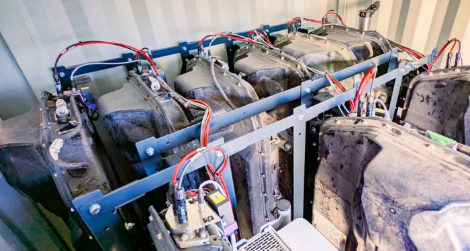
One stream consists of hybrid EV batteries. These batteries retain their original design, a key differentiator, making them ideal for repurposing. For example, the Japanese Plug-in Hybrid Electric Vehicle (PHEV) batteries were produced by an Original Equipment Manufacturer (OEM) consortium that no longer exists, requiring reverse engineering. They provide 5 to 7 kWh per battery and are used in power applications like construction (e.g., crane towers), with up to nine packs forming a 65-kWh battery.
A second stream includes electric bus batteries. Their scale is growing over time, and about 3 to 6 bus batteries are needed per neighbourhood energy system. Bus operators, as owners, see this as a responsibility towards waste. While income is lower, it also offers marketing value; they showcase second-life batteries in depots as a green initiative.
A third stream is composed of electric bike batteries. These are flexible for both power and energy uses and help stabilize the supply chain. They require more adjustments, such as voltage balancing and repackaging, and are handled by a business-to-business remanufacturing partner who validates and repackages them at the cell level.
And finally, a fourth emerging stream consists of regular EV batteries, which hold significant long-term potential. As large fleets of EVs from manufacturers such as Tesla, Mercedes-Benz, BYD and others progressively reach end-of-life over the coming years, substantial volumes of high-capacity battery packs are expected to enter second-life markets. Unlike hybrid systems, these batteries typically offer larger capacities and are likely to become available through structured agreements with OEMs, leasing companies, fleet operators, insurers, or specialized dismantling and remanufacturing supply chains. Although this stream might not be part of the current BatteREstore implementation, it represents a key future opportunity for scaling second-life storage solutions.
As previously indicated, the lack of first-life information remains a key challenge in properly assessing the true state of the batteries. This lack of data limits strategic decision-making and hinders the scalability of the second-life model. Thus, alongside its social and environmental benefits, policy support is vital. We must ensure responsibility for the batteries’ destination, promote interoperability, foster cybersecurity design, and improve data availability; ultimately, standardization is key to protecting consumers and ensuring affordability.
Designing cost-effective second-life systems
The ideal system, from a quality perspective, would involve full disassembly down to the cell level; however, this is cost-ineffective. Consequently, the key is repurposing rather than rebuilding: as previously indicated, the goal is to reuse batteries as they were in their first life, without physical modification.
Keeping the original packaging is efficient, but wiring connections present a challenge. Ideally, the repurposer would communicate directly with the original manufacturer to understand its technical protocols and system architecture. In the case of buses, the bus operator is central to the interaction between Greeny Energy and the vehicle manufacturer, facilitating this dialogue. Thus, for the manufacturer, this initiative is driven by the customer, giving it greater weight and credibility.
Another technically important aspect highlighted by this project is the potential for a third-life application for battery storage, beyond the second. In this model, batteries have a first life in mobility, a second life in industrial applications such as construction sites, and a third life as neighbourhood batteries. This transition from second to third life involves adapting capacities by adjusting both energy ratings and power thresholds. In practice, a typical adaptation involves replacing the battery inverter with a unit of lower or higher power, and adding or removing battery packs as needed. The key is to design the system intelligently without compromising quality.
On-site reconfiguration is particularly relevant in this context, as it may help avoid transportation-related challenges. Transporting used batteries after their first life, and before repurposing, is hazardous, adding complexity to the process. While workshop-based work might be more comfortable, round-trip transport is complex and problematic, as batteries are classified as hazardous waste. Hence, reducing transportation requirements not only lowers costs and risks but can also contribute to improving overall system quality.
As Greeny Energy steps forward, it effectively becomes a new battery operator, similar to a manufacturer, because the batteries undergo repurposing from EV to stationary use. This shift in responsibility allows Greeny Energy to assume liability, fostering trust and enabling insurance coverage. Strong traceability and reporting from the first user are essential, as even when the state of health drops below 100%, there are still usable hours. This allows Greeny Energy’s main value proposition to emerge: the ability to replace the storage system if needed, not only building trust but also reducing perceived risk.
Learning by deploying: the batteREstore approach
The implementation of these systems is organized in two main stages. In the first stage, which will be carried out as soon as possible, the emphasis is on field experience, gathering direct feedback and user interaction. This operational experience will be crucial, as it will generate essential know-how. Greeny Energy will lead this effort, beginning with a peak shaving system at a construction site, expected after the summer 2026, using an EV-type power battery, potentially adaptable to a neighbourhood application in a further moment .
In addition, in this first stage of the project, an additional energy system will be deployed in its third life, serving as a neighbourhood battery, expected before winter 2027, using bus batteries; the Symphonie social centre is a potential location for this experience.
In the second stage, three tailor-made systems will be implemented, each adapted to emerging needs, with a strong focus on learning from the transition between second and third life.
Operational experience will be fundamental, as these pilots will generate invaluable industrial know-how. Greeny Energy already brings substantial experience, having worked with 20 peak-shaving containers—typically used at construction sites. These containers form the first wave, required reverse engineering for their development, and are systems offered to clients as part of a rental solution. Furthermore, Greeny Energy collaborates with crane manufacturers to develop integrated packs that combine cranes and second-life battery storage systems, adding significant industrial credibility to the entire approach.
Towards a circular battery ecosystem
In conclusion, the shift from second-life batteries to a truly circular energy system does not rely solely on battery chemistry; it depends on building trusted, traceable, and economically viable industrial ecosystems. By anchoring system engineering at the heart of this process, Greeny Energy is not just repurposing batteries; it is fostering a new paradigm of sustainable value that is demonstrated in practice in batteREstore. In doing so, they contribute not only to reducing waste, but also to creating a more conscious approach to energy in the city of Tilburg, one that balances environmental stewardship with industrial innovation.
Sources
Online document : Beyond Recycling: Unlocking the Potential of Second-Life Batteries for Urban Communities