Financial aid and charges in Loire-Bretagne: to improve the quality of water and aquatic environments
Agence de l’eau Loire-Bretagne(Loire-Bretagne Water Agency), octubre 2019
Faced with repeated droughts since 2003, farmers in the Deux-Sèvres have had to rethink their water management.
Denis Mousseau, a cereal farmer with 266 ha of land (60 of which are organically farmed), epitomises this transition: a drastic reduction in water abstraction (from 151,000 to 60,000 m³), conversion to organic farming, and involvement in a water cooperative to create 16 alternative water reserves (7 million m³).
Supported by the Sèvre-Niortaise-Mignon Territorial Quantitative Management Contract (CTGQ), this project combines technical innovation (sustainable irrigation, drip irrigation) with agroecological practices (grass strips, cover crops, hedgerows).
A collective and virtuous initiative, supported by €28 million from the Water Agency, which demonstrates that agricultural resilience and the preservation of water resources can go hand in hand.
Para descargar: pratiques_agricoles_-_economies_d_eau_-_deux-sevres_-_aides_et_redevances_-_agence_de_l_eau_loire-bretagne-fr.pdf (820 KiB)
Changing farming practices to conserve and make the most of water
The Deux-Sèvres Chamber of Agriculture manages water resources quantitatively with the support of the water cooperative. The cooperative is leading a project to create 16 alternative reservoirs to store nearly 7 million m³ of water as part of the Sèvre Niortaise-Mignon territorial quantitative management contract.
In the Courance and Mignon catchment area, Denis Mousseau, a cereal farmer with 266 ha of land, 60 of which are farmed organically, is involved in this cooperative. Following a collective discussion on how to ensure the equitable sharing of water, he has adapted his farming practices.
Managing the available water supply
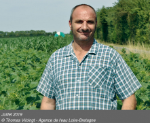
Denis Mousseau :
“ Since 2003, there have been successive spells of drought and, like all farmers, I have often had to cope with irrigation restrictions and bans. For my cereal farm, storing water in winter to reuse it during periods of drought was essential to guarantee my production and my income. I was therefore more than happy to take part in the discussions organised with all irrigators to manage and share water more effectively. ”
Making the best use of available water
“ In the 2000s, I had water rights amounting to 151,000 m³. In 2010, I seized the opportunity to apply for financial support to undertake an agri-environmental measure known as ‘de-irrigation’. The aim was to reduce the volume of water to 60,000 m³, with a view to securing this volume through winter storage. I chose to decommission a borehole located 12 km from the farm, which had been used to irrigate 35 hectares of maize. In 2017, following my partner’s departure, I ceased dairy farming and began to give more serious thought to changing my production system. Eighteen months later, I converted 60 ha to organic farming around the farm’s main premises. To control weeds effectively, extending crop rotations by introducing alfalfa and spring crops – including open-field vegetables – proved essential. These crops need to be irrigated to achieve a sufficient yield and ensure the economic viability of my farm. I have chosen to irrigate only these crops. ”
Committed to water quality
“ Together with other farmers, I have established grass strips, catch crops and hedgerows, in addition to converting to organic farming. I have made a conscious decision to no longer irrigate between 9 am and 7 pm, which limits water loss through evaporation. Thanks to the collective effort undertaken, this is now the case for 95 per cent of farmers in the area. ”
Individual and collective commitments to water quality and sound water management Denis Mousseau’s approach forms part of the memorandum of understanding for the Sèvre Niortaise-Mignon Territorial Quantitative Management Contract (CTGQ), signed in December 2018. Each farmer makes binding commitments, such as :
-
a farm assessment,
-
commitments to reduce the use of plant protection products,
-
to move towards more water-efficient farming practices,
-
and to preserve biodiversity.
Towards new investments
“ I am eagerly awaiting the construction and commissioning of the substitute reservoirs so that I can have access to the volume of water essential for my crops. With the guarantee of having 60,000 m³ of water thanks to the storage facilities, I am planning to invest in more efficient irrigation equipment: drip irrigation, irrigation booms… My partner and I would like to offer locally sourced produce. To this end, we wish to set up an organic poultry farm. This will enable us to manage crop fertilisation more effectively and achieve self-sufficiency by using organic matter from the poultry farm as fertiliser for our crops. ”
Julien Moureau (Councillor at the Deux-Sèvres Chamber of Agriculture) :
“ The dialogue, initiated within the framework of the Sèvre Niortaise-Mignon CTGQ, enabled everyone to better understand each other’s expectations in order to find the best compromise. The agreement reached in 2018 sets out individual commitments. Funding of over 28 million euros from the Loire-Bretagne Water Agency is earmarked for the creation of 16 alternative reservoirs capable of storing 7 million m³ of water. ”
Referencias
Loire-Bretagne Water Agency document : Aides et redevances en Loire-Bretagne : pour améliorer la qualité de l’eau et des milieux aquatiques - Subsidies and charges in the Loire-Bretagne region: to improve the quality of water and aquatic environments