Encouraging elected representatives to get involved in the roll-out of source-separated bio-waste collection. The experience of Seine Normandie Agglomération
5 pilot schemes to promote the sorting of bio-waste at source
junio 2026
Agence pour l’Environnement et la Maîtrise de l’Energie (ADEME)
The sorting of bio-waste at source is now a major challenge for local authorities seeking to reduce the proportion of residual waste and meet their obligations. However, its implementation requires a strong commitment from local elected representatives.
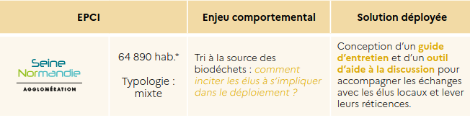
The project team at Seine Normandie Agglomération has therefore focused its efforts on identifying the obstacles faced by this key link in the decision-making chain, in order to prepare for the roll-out of source separation.
Para descargar: 2026_06__guide_concertation_biodechets_fr.pdf (5 MiB)
Diagnosis
A preliminary study was carried out through three interviews in three different local authorities :
-
an individual interview with a mayor ;
-
a group interview involving a mayor and an administrative director ;
-
a group interview with the Director-General of Services, the Deputy Director-General and the technical services.
| “ The support was incredibly interesting : the sociological perspective, the way the subject was approached using the proposed method, the academic angle. It took us out of our usual working routines. I thought it was brilliant. ” |
These discussions helped to identify :
-
significant concerns regarding the hygiene of the collection system (potential presence of rats, odours, or cleanliness around communal collection points) ;
-
a lack of awareness of the various systems and solutions available ;
-
confusion regarding the division of roles and responsibilities between the local authority, the technical services and the elected representatives themselves.
Solution developed
The interviews themselves helped to overcome certain reservations by correcting misconceptions, clarifying roles, etc.
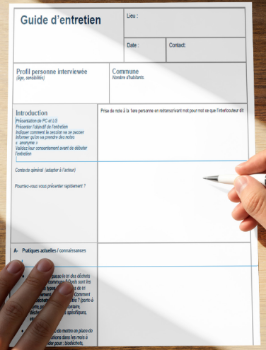
However, building on this, the project team created a prototype guide designed to equip future teams who will be meeting with elected representatives in their local areas. This dynamic and iterative guide includes, in particular :
-
advice on planning and preparing for the interview;
-
advice on ensuring a lively and constructive exchange, and identifying the obstacles and opportunities that elected representatives might raise;
-
suggested courses of action to address the obstacles identified.
The solution was developed to follow three key principles :
-
To create a space for dialogue in which elected representatives feel heard, understood and not judged. This supportive environment fosters a constructive approach and builds trust in the relationship. Simply taking part in an interview can encourage elected representatives to articulate their positions, clarify their views and take the first step towards action.
-
Clarifying everyone’s roles and responsibilities to remove areas of uncertainty and reduce ambiguities regarding who is responsible for taking action – issues that often act as a major barrier to progress.
-
Clarifying everyone’s responsibilities (elected representatives, technical departments, the urban area) can facilitate decision-making.
-
Drawing on feedback to reassure: addressing elected representatives’ concerns by highlighting feedback and concrete, successful examples of schemes implemented in comparable areas strengthens their confidence in the feasibility of source separation and reduces their sense of risk.
Referencias
ADEME document : Supporting the transition to source separation of bio-waste: The example of five local authorities in Normandy, in French
Extract: the experience of Seine Normandie Agglomération, pages 14–15